
Connected Industrial IoT Devices for OEM Vehicle Manufacturing
Industrial AIoT devices for OEM vehicle manufacturing including UWB RTLS tags, RFID systems, BLE device, smart factory wearables, VIN traceability hardware, torque verification device, industrial gateways, private 5G infrastructure, and automotive assembly plant positioning systems.
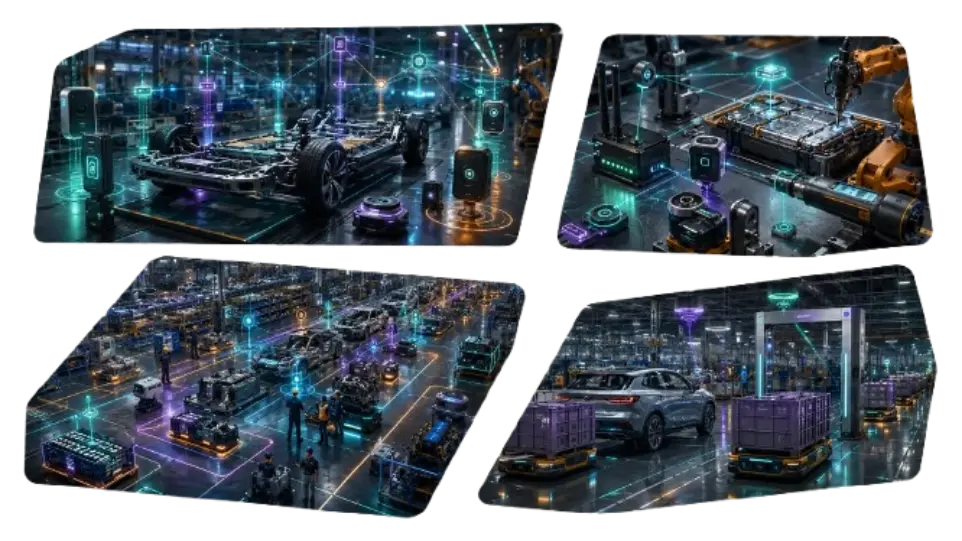
Connected Industrial IoT Devices for OEM Vehicle Manufacturing
AIoT Hardware Infrastructure for Automotive Assembly Plants, Vehicle Production Operations, Smart Factory Traceability, and Industrial Workforce Visibility
Connected industrial IoT devices have become operational infrastructure across modern OEM vehicle manufacturing environments where automotive assembly plants, body shops, paint shops, battery assembly operations, powertrain manufacturing lines, sequencing centers, and finished vehicle logistics yards depend on continuous real time operational visibility. Automotive manufacturers increasingly deploy AI-enabled IoT hardware systems to improve VIN genealogy tracking, workforce safety compliance, intralogistics coordination, material flow synchronization, and production execution system throughout highly automated smart factory system.
OEM automotive manufacturing environments require industrial IoT hardware capable of operating reliably within robotic welding zones, conveyor-intensive assembly operations, automated storage systems, paint curing facilities, high EMI production areas, and large outdoor vehicle compounds. Industrial wireless infrastructures must support deterministic communication, low latency positioning, scalable edge connectivity, and continuous telemetry collection across thousands of simultaneously connected industrial devices.
OEM Vehicle Manufacturing AI provides connected AIoT device system specifically designed for automotive OEM production workflows including final vehicle assembly, body-in-white operations, chassis production, powertrain assembly, supplier sequencing, battery module manufacturing, and smart intralogistics environments. These industrial IoT systems combine RTLS positioning systems, RFID infrastructure, UWB location system, BLE industrial device, edge AI gateways, industrial Wi-Fi 6 connectivity, and private 5G systems to support connected automotive manufacturing operations.
Automotive OEMs increasingly depend on industrial IoT hardware to coordinate just-in-sequence inventory delivery, automate line-side replenishment, monitor returnable transport items, validate torque operations, improve AGV navigation, and strengthen traceability across vehicle production lifecycles. Connected IoT devices help manufacturers reduce production bottlenecks, minimize asset search time, improve manufacturing execution visibility, and support AI-driven operational analytics across multi-plant automotive production networks.
Connected AIoT Device Applications in OEM Vehicle Manufacturing
Industrial IoT devices support a broad range of automotive manufacturing workflows throughout vehicle production environments including:
- Body-in-white production monitoring
- Automotive welding cell positioning
- VIN traceability synchronization
- Final assembly torque verification
- Just-in-sequence inventory coordination
- Smart factory workforce tracking
- AGV fleet positioning
- Automotive conveyor synchronization
- Forklift and pedestrian collision prevention
- Paint shop environmental monitoring
- Vehicle yard logistics system
- Battery production material traceability
- Returnable rack tracking
- Automotive supplier flow visibility
- Automated storage and retrieval system monitoring
- Manufacturing execution system integration
- Real time production cycle analytics
- Smart intralogistics coordination
- Automotive quality inspection automation
- Industrial edge telemetry collection
Automotive manufacturers deploy these industrial IoT systems to improve throughput, strengthen manufacturing traceability, optimize labor utilization, support predictive maintenance strategies, and improve production continuity across high-volume vehicle assembly operations.
Workforce Tracking Devices for Automotive Manufacturing Plants
Automotive OEM facilities require real time workforce visibility technologies capable of supporting operational safety, labor coordination, restricted area governance, and emergency response management throughout large-scale production campuses. Workforce tracking devices help manufacturers improve operational awareness across assembly lines, robotics zones, logistics corridors, maintenance areas, and hazardous production environments.Industrial workforce visibility systems commonly combine ultra-wideband positioning systems, BLE industrial beacons, RFID personnel credentials, wearable safety device, and AI-enabled occupancy analytics systems.
UWB Personnel Tags for Automotive Assembly Operations
Ultra-wideband personnel tracking tags provide centimeter-level positioning accuracy for automotive assembly line operators, maintenance technicians, quality assurance teams, robotics specialists, and contractor personnel. UWB RTLS systems support high precision workforce visibility required for human-machine separation monitoring and restricted zone enforcement near robotic welding cells and automated manufacturing systems.
Automotive production applications include:
- Assembly line operator positioning
- Body shop workforce mapping
- Welding cell occupancy analytics
- Paint booth access monitoring
- Emergency evacuation accountability
- Maintenance team dispatch visibility
- Restricted robotics zone enforcement
- Battery production safety monitoring
UWB positioning systems are particularly valuable in high-density automotive manufacturing facilities where conventional GPS systems cannot provide indoor positioning accuracy.
Industrial Smart Wearables
Automotive manufacturing environments increasingly deploy industrial smart wearables to improve workforce safety compliance and operational solution. Ruggedized wearable devices help manufacturers monitor PPE usage, environmental exposure, fatigue risk, and emergency incidents throughout vehicle production operations.
Industrial wearable technologies may include:
- Smart safety helmets
- PPE compliance device
- Voice-enabled industrial wearables
- Worker fatigue monitoring devices
- Industrial smart watches
- Environmental gas exposure device
- Emergency panic alert devices
These wearable technologies support safer manufacturing environments across welding operations, battery assembly facilities, paint shops, and automated material handling zones.
BLE Worker Badges for Smart Factory Workforce Analytics
Bluetooth Low Energy worker badges support scalable workforce monitoring across automotive production campuses, sequencing warehouses, logistics staging areas, and vehicle assembly operations. BLE infrastructures provide cost-effective personnel visibility while supporting long battery lifecycles and flexible deployment systems.
BLE workforce systems commonly support:
- Shift transition visibility
- Workforce utilization analytics
- Labor movement tracking
- Production staffing coordination
- Contractor activity monitoring
- Smart factory occupancy system
Access Authentication Devices for Automotive OEM Facilities
Automotive manufacturing plants maintain strict workforce authentication requirements across body shops, prototype development centers, battery production facilities, data centers, hazardous material zones, and automated robotics environments. Industrial access authentication systems support operational security, workforce governance, and compliance enforcement throughout automotive production campuses.
Biometric Access Readers
Biometric access control systems provide secure workforce authentication across automotive manufacturing operations where operational continuity and restricted access governance are critical. Biometric systems support workforce identity validation while improving access audit visibility.
Automotive OEM facilities commonly deploy:
- Fingerprint authentication systems
- Facial recognition terminals
- Iris recognition readers
- Multi-factor industrial authentication
- Workforce authorization logging
- Visitor access governance systems
RFID Entry Scanners
RFID access control systems support rapid workforce throughput across automotive manufacturing plants with large employee populations and multiple controlled production areas. RFID authentication technologies are widely used for assembly plant access management, contractor authorization, warehouse security, and logistics checkpoint visibility.
Automotive applications include:
- Production floor access validation
- Battery assembly authorization
- Tool crib security management
- Vehicle yard checkpoint monitoring
- Supplier facility access control
- Warehouse entry authentication
Facial Recognition Terminals
AI-enabled facial recognition systems provide touchless workforce authentication for automotive manufacturing facilities where gloves, PPE equipment, or contamination controls reduce the practicality of traditional badge systems. Facial recognition technologies help streamline shift transitions and plant entry operations.
Asset Tracking Devices for Automotive Production Environments
Automotive assembly operations depend on continuous visibility across tooling assets, returnable containers, mobile carts, forklifts, AGVs, robotic fixtures, and production support equipment. Industrial asset tracking devices help manufacturers optimize material flow coordination, improve equipment utilization, and reduce operational delays.
UWB Asset Tags
Ultra-wideband asset tracking systems provide high precision positioning for critical manufacturing assets within automotive production environments. UWB technologies support accurate real time visibility across tooling operations, robotics support equipment, and intralogistics workflows.
Automotive manufacturing applications include:
- Torque wrench tracking
- Welding fixture positioning
- AGV fleet visibility
- Mobile workstation monitoring
- Sequencing cart tracking
- Robotics tooling coordination
- Battery handling equipment monitoring
RFID Container Tags
RFID container tracking systems support visibility for returnable transport items throughout automotive supply chain operations. Automotive OEMs deploy RFID-enabled tracking systems to monitor racks, pallets, totes, and reusable shipping containers across supplier logistics workflows.
RFID infrastructures help improve:
- Sequenced parts visibility
- Dock receiving automation
- Container circulation analytics
- Cross-plant logistics coordination
- Supplier shipment verification
- Inventory reconciliation workflows
GPS Yard Trackers
GPS-enabled industrial trackers provide outdoor visibility for finished vehicle yards, trailer staging operations, outbound logistics coordination, and automotive carrier management. Large automotive vehicle compounds require scalable outdoor positioning systems capable of supporting high-volume vehicle movement operations.
Inventory Monitoring Devices for Just-in-Sequence Manufacturing
Automotive OEM production systems rely heavily on just-in-time and just-in-sequence inventory operations where material shortages or sequencing errors can disrupt vehicle assembly throughput. Industrial inventory monitoring devices support continuous material visibility and automated replenishment coordination.
Smart Shelf Device
Smart shelf monitoring systems provide real time inventory visibility for line-side automotive components, electronic control modules, fasteners, assemblies, and manufacturing consumables.
Automotive smart inventory systems support:
- Automated material replenishment
- Kanban synchronization
- Inventory shortage prevention
- Production consumption analytics
- Sequenced parts coordination
- Line-side inventory visibility
RFID Inventory Readers
RFID inventory readers support high-speed automated scanning throughout automotive warehouses, sequencing facilities, production lines, and cross dock operations. RFID infrastructures help reduce manual inventory processing while improving inventory accuracy.
Common automotive manufacturing workflows include:
- Pallet verification
- Sequenced component validation
- WIP inventory visibility
- Receiving automation
- Finished goods reconciliation
- Returnable asset tracking
Environmental Storage Device
Environmental monitoring systems support storage compliance for automotive batteries, coatings, adhesives, electronics, chemicals, and specialty materials requiring controlled environmental conditions.
Production Traceability Devices for VIN Genealogy and Manufacturing Quality
Automotive manufacturing operations require end-to-end production traceability to support VIN genealogy, warranty investigations, regulatory compliance, supplier accountability, and manufacturing quality assurance.
VIN Barcode Scanners
Industrial VIN barcode scanners support high-speed vehicle identification throughout automotive production workflows including chassis tracking, assembly synchronization, inspection verification, and outbound logistics coordination.
Barcode scanning systems commonly support:
- Vehicle body identification
- Chassis synchronization
- Production sequence validation
- Quality inspection workflows
- Assembly verification
- Shipping coordination
Vision Inspection Cameras
AI-enabled industrial machine vision systems support automated automotive quality inspection and manufacturing defect detection across vehicle assembly operations. Vision inspection technologies improve production consistency while reducing manual inspection requirements.
Automotive vision systems may monitor:
- Weld integrity validation
- Paint finish inspection
- Fastener presence detection
- Component assembly verification
- Surface defect analytics
- Torque sequence confirmation
Torque Verification Device
Torque verification systems monitor fastening operations across automotive final assembly lines to support manufacturing compliance, quality traceability, and assembly validation requirements. These systems are widely used throughout chassis assembly, drivetrain installation, battery pack assembly, and vehicle interior integration workflows.
Industrial Device Infrastructure for Smart Automotive Factories
AIoT Compliance, Safety Standards, and Regulatory Frameworks for OEM Vehicle Manufacturing
OEM vehicle manufacturing environments require compliance across automotive production safety, industrial automation, functional safety, industrial cybersecurity, workforce protection, robotic systems, connected manufacturing infrastructure, RTLS deployments, industrial wireless networking, and AI-enabled manufacturing execution systems. AIoT deployments supporting workforce tracking, access control, asset visibility, sequencing operations, intralogistics, WIP monitoring, and VIN traceability must align with automotive manufacturing standards governing operational safety, industrial networking, robotics integration, cybersecurity, and quality assurance.
AI-enabled people tracking systems, UWB RTLS infrastructure, RFID automotive inventory systems, BLE workforce badges, industrial edge gateways, AI video analytics, forklift proximity monitoring, automated yard management, and MES-connected traceability systems are increasingly integrated into body shop operations, paint shop production, final vehicle assembly, sequencing warehouses, supplier logistics networks, battery assembly environments, and finished vehicle compounds.
The following standards and regulations are among the most relevant frameworks for AIoT-enabled OEM vehicle manufacturing operations.
Wireless Technologies Used in Automotive AIoT Deployments
Automotive OEM facilities use multiple industrial wireless technologies depending on latency requirements, positioning precision, environmental constraints, and production workflow objectives.
Ultra-Wideband Positioning Systems
UWB technologies support centimeter-level positioning accuracy for automotive workforce visibility, AGV navigation, tooling coordination, and manufacturing safety systems.
Bluetooth Low Energy Infrastructure
BLE systems support scalable asset visibility, workforce tracking, environmental monitoring, and industrial beacon applications across automotive production campuses.
RFID Automotive Tracking Systems
RFID remains one of the most widely deployed industrial tracking technologies for automotive inventory management, returnable container monitoring, VIN traceability, and warehouse automation.
Private 5G Smart Factory Connectivity
Private 5G infrastructures support low latency industrial communication and high-density device connectivity across automotive assembly plants and smart manufacturing campuses.
Industrial Wi-Fi 6 Networks
Wi-Fi 6 technologies support high-bandwidth industrial communication for handheld terminals, robotics systems, AI vision inspection stations, tablets, and industrial edge computing environments.
Ruggedized Industrial Hardware for Automotive Manufacturing
Automotive production facilities require industrial IoT hardware engineered for continuous operation within demanding manufacturing environments involving robotic welding systems, conveyor networks, stamping presses, curing ovens, and automated machinery.
Ruggedized industrial IoT devices commonly support:
- IP-rated industrial enclosures
- Shock-resistant hardware designs
- Industrial temperature tolerance
- Electromagnetic interference protection
- Chemical exposure resistance
- Dust and debris protection
- High vibration durability
- Extended operational lifecycles
Automotive-grade industrial IoT hardware must maintain stable connectivity and reliable telemetry collection throughout continuous vehicle production operations.
Edge Connectivity Devices for Automotive Manufacturing System
Industrial edge connectivity devices support localized data processing, low latency analytics, and distributed operational solution across automotive manufacturing environments. Edge computing systems help reduce network congestion while supporting real time manufacturing visibility.
Industrial edge infrastructures commonly include:
- Industrial IoT gateways
- Edge AI processing appliances
- Industrial network switches
- Protocol conversion gateways
- MQTT edge brokers
- Factory telemetry concentrators
- Device aggregation controllers
- Real time edge buffering systems
These industrial edge systems help automotive manufacturers integrate operational technologies with MES, ERP, SCADA, PLM, warehouse management systems, robotics systems, and digital twin environments.
Automotive Manufacturing Deployment Environments
Connected industrial IoT devices deployed within OEM automotive manufacturing environments must support reliable operation across multiple production workflows and environmental conditions.
Body Shop Operations
Body shop environments require ruggedized IoT hardware capable of operating near robotic welders, automated framing systems, conveyor infrastructures, and high EMI production areas.
Paint Shop Monitoring
Paint operations require environmental device, hazardous zone tracking systems, workforce safety wearables, and humidity-sensitive monitoring infrastructure.
Final Assembly Operations
Final assembly lines depend on torque verification systems, workforce positioning technologies, inventory synchronization device, and production execution visibility systems.
Vehicle Yard Management
Finished vehicle compounds require GPS-enabled tracking infrastructure, long-range wireless communication systems, and outdoor positioning technologies.
Supplier Sequencing Facilities
Automotive sequencing centers rely heavily on RFID systems, barcode scanning infrastructure, inventory visibility device, and real time material coordination systems.
OEM Vehicle Manufacturing AI Expertise
OEM Vehicle Manufacturing AI combines decades of industrial IoT deployment experience with deep expertise in automotive manufacturing operations, industrial wireless infrastructure, RTLS positioning systems, smart factory analytics, and connected manufacturing technologies. The organization was developed within Aperture Venture Studio with support from GAO and draws upon extensive experience supporting thousands of industrial IoT deployments across complex manufacturing environments.
Engineering teams include industrial IoT specialists, wireless infrastructure architects, edge computing professionals, manufacturing systems engineers, and Ph.D.-level technical leadership experienced in large-scale industrial AIoT deployments. The organization has supported Fortune 500 manufacturers, research institutions, government organizations, and industrial operators requiring scalable, secure, and operationally reliable industrial IoT systems.
Automotive OEM manufacturers require AIoT infrastructures capable of supporting manufacturing continuity, operational safety, traceability integrity, cybersecurity governance, and real time production system. OEM Vehicle Manufacturing AI supports these objectives through industrial-grade IoT hardware system, rigorous quality assurance practices, scalable integration systems, and automotive-focused deployment expertise tailored for connected vehicle manufacturing operations.
U.S. and Canadian Standards and Regulations for AIoT in OEM Vehicle Manufacturing
Automotive Manufacturing Functional Safety, Smart Factory Cybersecurity, Industrial IoT Compliance, and Connected Vehicle Production Standards
Automotive OEM manufacturing facilities deploying AI-enabled workforce safety systems, RTLS positioning infrastructure, RFID inventory tracking, industrial edge computing, connected factory automation, and AIoT production traceability systems must comply with a broad range of automotive manufacturing, industrial automation, worker safety, cybersecurity, industrial wireless communication, and manufacturing quality regulations across the United States and Canada.
Automotive Manufacturing Quality and Functional Safety Standards
- ISO 26262 Road Vehicle Functional Safety
- IATF 16949 Automotive Quality Management Systems
- ISO 9001 Quality Management Systems
- ISO 21434 Road Vehicle Cybersecurity Engineering
- SAE J3061 Cybersecurity Guidebook for Cyber-Physical Vehicle Systems
- SAE J1939 Vehicle Bus Communication Standard
- ISO 14229 Unified Diagnostic Services
- ISO 24089 Automotive Software Update Engineering
- AIAG CQI Automotive Process Standards
- MMOG/LE Automotive Supply Chain Standards
Industrial IoT, Smart Factory, and Industrial Automation Standards
- IEC 62443 Industrial Automation and Control Systems Security
- ISA/IEC 62443 Industrial Cybersecurity Framework
- IEC 61508 Functional Safety Standard
- ISO 13849 Safety of Machinery
- OPC UA IEC 62541 Industrial Communication Standard
- MQTT OASIS Messaging Standard
- IEEE 802.11 Wi-Fi Standards
- 3GPP Private 5G Industrial Communication Standards
- Bluetooth SIG BLE Standards
- EPCglobal RFID Standards
- ISO 17363 RFID Freight Container Standards
- ISO 18185 Electronic Seal Standards
- UL 61010 Industrial Electrical Equipment Safety
- UL 508A Industrial Control Panels
- NFPA 70 National Electrical Code
- NFPA 79 Electrical Standard for Industrial Machinery
Workforce Safety, Access Control, and Industrial Facility Regulations
- OSHA 29 CFR 1910
- OSHA Lockout/Tagout Standard 1910.147
- OSHA Powered Industrial Truck Standard 1910.178
- ANSI/RIA R15.06 Industrial Robot Safety
- ANSI B11 Machine Safety Standards
- CSA Z432 Safeguarding of Machinery
- CSA Z434 Industrial Robots and Robot Systems
- ISO 45001 Occupational Health and Safety Management Systems
- Canadian Centre for Occupational Health and Safety Regulations
- WHMIS Workplace Hazardous Materials Information System
Automotive Traceability, Data Governance, and Industrial Cybersecurity Standards
- NIST Cybersecurity Framework
- NIST SP 800-82 Industrial Control System Security
- ISO/IEC 27001 Information Security Management
- ISO/IEC 27701 Privacy Information Management
- GDPR Cross-Border Data Governance
- PIPEDA Canadian Data Protection Regulation
- FCC Part 15 Wireless Communication Compliance
- TREAD Act Vehicle Traceability Compliance
- EPA Hazardous Waste Regulations
- Transport Canada Motor Vehicle Safety Regulations
Top Players in OEM Vehicle Manufacturing
Automotive Manufacturing AIoT Leaders, Industrial RTLS Vendors, RFID Providers, Industrial Wireless Infrastructure Companies, and Smart Factory Automation Organizations
- Siemens
- Rockwell Automation
- Honeywell
- Zebra Technologies
- Bosch
- Cisco
- Schneider Electric
- ABB
- SICK AG
- Impinj
- HID Global
- Ubisense
- Litum
- Sewio
- Advantech
- Moxa
- Quectel
- Juniper Networks
- Ericsson
- Nokia
Case Studies
U.S. Automotive OEM Manufacturing Case Studies
UWB Workforce Safety and Human-Machine Separation in Detroit, Michigan
Problem
A high-volume automotive OEM assembly plant operating robotic body-in-white welding cells and automated conveyor transfer systems experienced recurring near-miss safety incidents involving forklift traffic, maintenance personnel, and mobile production equipment. Manual workforce visibility methods could not provide real time location awareness across chassis framing zones, robotic weld lines, and AGV corridors.
Solution
We implemented an AI-enabled industrial RTLS system using UWB personnel tags, BLE workforce badges, industrial edge gateways, and AIoT occupancy analytics integrated with manufacturing execution systems and plant safety infrastructure. Human-machine separation alerts were configured near robotic welding stations, conveyor merge points, and automated material delivery pathways. Workforce access control systems were synchronized with restricted robotics maintenance zones and lockout/tagout workflows.
Result
The automotive assembly operation reduced forklift-related near-miss incidents by 41% while improving emergency muster accountability from approximately 18 minutes to under 4 minutes. Real time workforce visibility improved operational coordination across body shop production cells and final vehicle assembly operations.
Lesson Learned
Metal-intensive automotive body shop environments required optimized UWB anchor calibration and RF tuning to maintain positioning accuracy near robotic weld cells and overhead conveyor infrastructure.
RFID Sequenced Parts Visibility and VIN Synchronization in Georgetown, Kentucky
Problem
An automotive OEM manufacturing facility operating just-in-sequence production workflows experienced intermittent VIN synchronization delays and sequencing errors involving powertrain installation and dashboard module staging operations. Manual inventory verification slowed takt time performance during peak production periods.
Solution
We deployed RFID inventory readers, BLE-enabled sequencing carts, VIN barcode scanning infrastructure, industrial MQTT gateways, and AIoT production synchronization analytics integrated with MES and ERP systems. Real time telemetry improved visibility across sequencing lanes, line-side inventory staging zones, and chassis assembly checkpoints.
Result
Sequencing-related production interruptions decreased by 36%, while VIN reconciliation efficiency improved by 52%. Automated RFID verification reduced manual scanning workloads during high-volume production shifts.
Lesson Learned
RFID antenna positioning required extensive testing around metallic returnable racks, conveyor assemblies, and moving vehicle body structures to maintain stable read accuracy.
Spartanburg, South Carolina SUV Manufacturing
Problem
An automotive OEM manufacturing facility operating just-in-sequence production workflows experienced intermittent VIN synchronization delays and sequencing errors involving powertrain installation and dashboard module staging operations. Manual inventory verification slowed takt time performance during peak production periods.
Solution
We deployed RFID inventory readers, BLE-enabled sequencing carts, VIN barcode scanning infrastructure, industrial MQTT gateways, and AIoT production synchronization analytics integrated with MES and ERP systems. Real time telemetry improved visibility across sequencing lanes, line-side inventory staging zones, and chassis assembly checkpoints.
Result
Sequencing-related production interruptions decreased by 36%, while VIN reconciliation efficiency improved by 52%. Automated RFID verification reduced manual scanning workloads during high-volume production shifts.
Lesson Learned
RFID antenna positioning required extensive testing around metallic returnable racks, conveyor assemblies, and moving vehicle body structures to maintain stable read accuracy.
Automotive Smart Factory Access Control in Spartanburg, South Carolina
Problem
A multi-building automotive manufacturing campus required stronger workforce authentication and contractor governance across EV battery assembly operations, paint shop facilities, and restricted robotics maintenance areas. Legacy badge systems lacked granular authorization visibility.
Solution
We implemented biometric access readers, RFID workforce credentials, AI-enabled facial recognition terminals, and centralized industrial access control analytics integrated with cybersecurity monitoring systems. Workforce authorization profiles were linked with maintenance schedules, hazardous zone protocols, and production planning systems.
Result
Unauthorized access events within restricted production zones declined by 67%, while workforce entry throughput improved by 29% during shift transitions across assembly operations.
Lesson Learned
Touchless authentication systems improved workforce throughput in PPE-intensive automotive production environments where gloves reduced biometric fingerprint scanner usability.
AGV Fleet Visibility and Intralogistics Coordination in Fremont, California
Problem
A smart automotive manufacturing operation experienced inconsistent AGV routing visibility and material staging delays across EV battery module assembly workflows and automated intralogistics corridors.
Solution
We deployed UWB asset tracking systems, RTLS positioning anchors, industrial edge analytics infrastructure, and AI-enabled route optimization systems integrated with warehouse orchestration systems and autonomous material handling software. Real time AGV telemetry improved visibility across battery staging zones and automated conveyor intersections.
Result
AGV traffic bottlenecks decreased by 33%, while material delivery cycle consistency improved by 24%. Production supervisors gained improved operational visibility across mobile cart utilization and tugger coordination workflows.
Lesson Learned
Low latency industrial edge processing was necessary to maintain stable RTLS positioning performance during high-volume intralogistics operations.
Automotive Torque Traceability and Assembly Validation in Arlington, Texas
Problem
A full-size vehicle assembly operation required improved fastening traceability across chassis integration, drivetrain assembly, and suspension installation workflows. Manual torque verification processes slowed manufacturing quality audits.
Solution
We deployed connected torque verification sensors, industrial IoT gateways, barcode validation systems, and AI-enabled production traceability analytics synchronized with VIN genealogy records and MES environments. Real time torque event telemetry was linked with vehicle assembly sequences.
Result
Assembly rework associated with fastening validation failures decreased by 31%, while quality audit preparation time improved by 48%. Automotive manufacturing traceability records became accessible in near real time.
Lesson Learned
Industrial edge buffering systems were required to preserve telemetry continuity during intermittent wireless congestion near robotic production cells.
RFID Returnable Rack Tracking in Chattanooga, Tennessee
Problem
An automotive manufacturing campus experienced recurring production delays caused by misplaced returnable transport racks, inconsistent supplier logistics visibility, and manual container reconciliation processes.
Solution
We implemented RFID container tags, BLE industrial beacons, GPS-enabled logistics trackers, and AIoT asset visibility dashboards integrated with dock scheduling systems and supplier logistics systems. Real time rack circulation analytics improved visibility across inbound material staging operations.
Result
Returnable rack search time decreased by 58%, while inbound material staging delays dropped by 27%. Dock scheduling coordination improved significantly during high-volume assembly periods.
Lesson Learned
Hybrid RFID and BLE tracking systems provided stronger operational coverage across mixed indoor and outdoor automotive logistics environments.
Paint Shop Environmental AIoT Monitoring in Bowling Green, Kentucky
Problem
An automotive paint operations facility required tighter environmental monitoring controls to improve coating consistency and workforce safety compliance within hazardous spray booth environments.
Solution
We deployed industrial environmental sensors, BLE workforce badges, hazardous zone occupancy monitoring systems, and industrial edge analytics integrated with centralized SCADA infrastructure. Sensor telemetry monitored humidity, airborne particulate exposure, workforce movement, and ventilation performance across paint curing and spray operations.
Result
Paint quality deviations associated with environmental fluctuations decreased by 22%, while compliance reporting workflows became substantially more automated.
Lesson Learned
Environmental sensor calibration schedules became critical due to thermal variation between curing zones, spray booths, and staging areas.
Finished Vehicle Yard Visibility and Carrier Coordination in Kansas City, Missouri
Problem
A large automotive outbound logistics yard experienced delays locating finished vehicles scheduled for carrier loading, rail staging, and dealer shipment coordination.
Solution
We implemented GPS-enabled vehicle yard tracking systems, BLE positioning gateways, industrial edge telemetry infrastructure, and AI-driven logistics analytics synchronized with transportation scheduling systems and yard management software.
Result
Finished vehicle retrieval time decreased by 46%, while outbound logistics throughput improved by 19% during peak shipping cycles. Manual search activity within the automotive logistics yard was significantly reduced.
Lesson Learned
Outdoor automotive yard deployments required weather-resistant enclosures and redundant industrial wireless communication paths to maintain operational continuity.
Canadian Automotive OEM Manufacturing Case Studies
Automotive Supplier Sequencing Visibility in Windsor, Ontario
Problem
A supplier sequencing operation supporting multiple automotive OEM assembly plants lacked real time visibility across sequenced dashboard modules, seating assemblies, and line-side inventory staging workflows.
Solution
We implemented RFID inventory readers, BLE warehouse positioning infrastructure, industrial handheld terminals, and AI-enabled sequencing analytics integrated with warehouse management and ERP systems. Material flow dashboards improved visibility across inbound and outbound logistics operations.
Result
Sequencing errors decreased by 39%, while inventory reconciliation efficiency improved by 44%. Dock throughput consistency improved during peak automotive production shifts.
Lesson Learned
Workforce training on RFID handling procedures significantly improved read reliability across high-speed sequencing operations.
Automotive Workforce Protection Analytics in Oakville, Ontario
Problem
An automotive assembly operation required stronger workforce safety monitoring near robotic welding cells, conveyor transfer points, and automated material delivery systems.
Solution
We implemented UWB workforce tracking systems, industrial smart wearables, AI-driven safety analytics, and emergency muster visibility systems connected to industrial edge gateways and plant safety infrastructure.
Result
Emergency response coordination improved substantially, while pedestrian near-miss incidents declined by 34% during the first operational year following deployment.
Lesson Learned
Continuous RTLS calibration improved positioning reliability within metallic automotive body shop environments.
EV Battery Assembly Asset Visibility in Ingersoll, Ontario
Problem
An electric vehicle battery assembly operation experienced limited visibility across mobile tooling assets, material handling carts, hazardous storage workflows, and battery module staging operations.
Solution
We deployed BLE asset beacons, RFID material tracking systems, industrial environmental monitoring sensors, and centralized AIoT visibility dashboards integrated with MES, industrial cybersecurity infrastructure, and warehouse orchestration systems.
Result
Mobile tooling search time decreased by 49%, while hazardous material inventory visibility improved significantly across EV battery module staging operations.
Lesson Learned
Battery manufacturing environments required additional wireless interference testing due to dense electrical equipment layouts and shielded production infrastructure.