Physical AI and AIoT for OEM Vehicle Manufacturing

OEMNex focuses on applying Physical AI and Artificial Intelligence of Things (AIoT) to the assets, equipment, and workflows of OEM vehicle manufacturing. The approach connects identification, sensing, AI-supported decisions, and appropriate physical action so manufacturing teams can work with more useful information about what is happening on the plant floor.

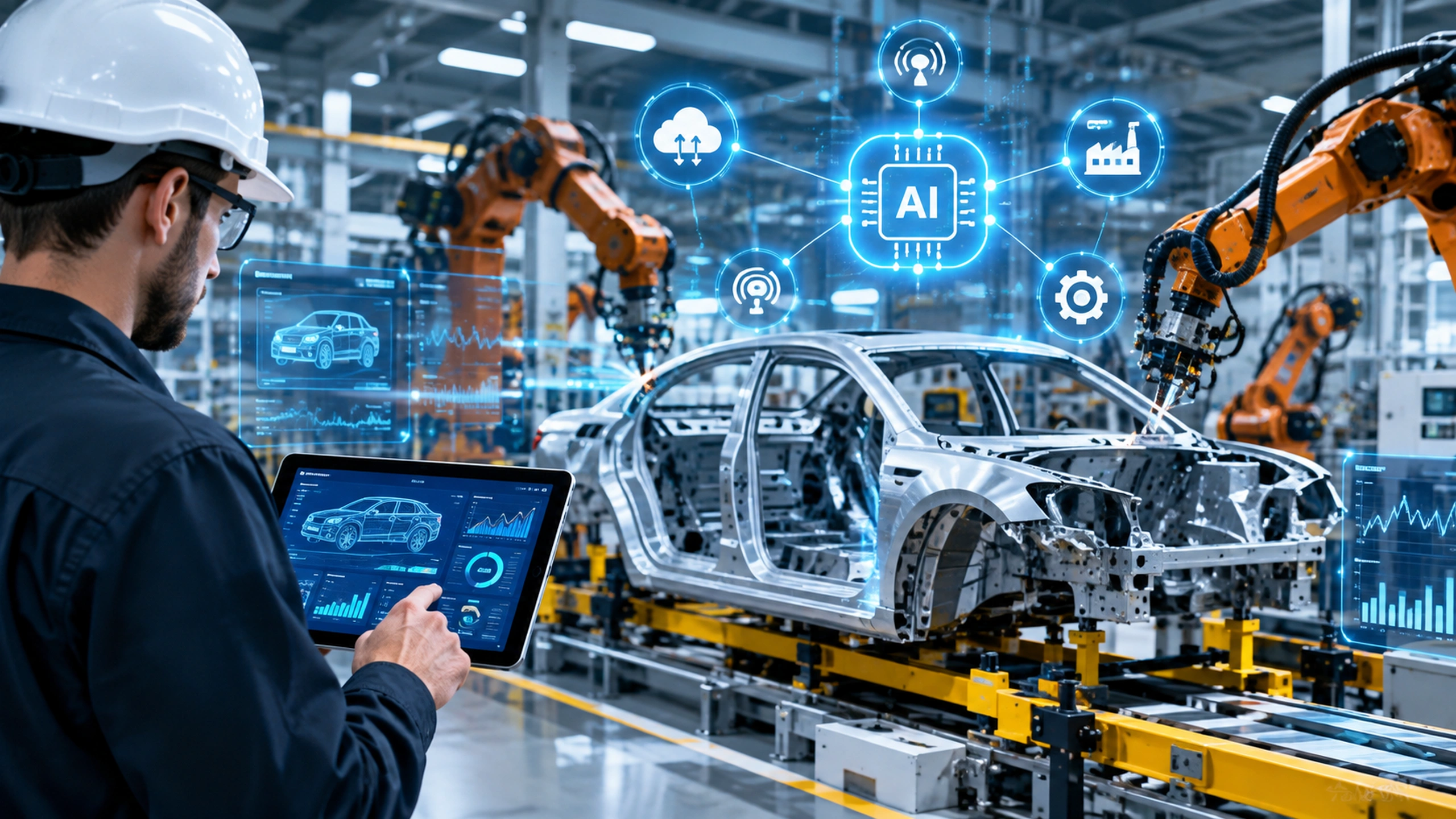
Automotive assembly line with robots, vehicle body, engineer, sensors, connectivity, and AI analytics.

For automotive OEMs, the practical question is not whether a connected factory can generate more data. The question is whether identity, condition, process state, and operational events can be captured with enough context to support a defined manufacturing decision. OEMNex structures Physical AI and AIoT around that workflow, with deployment choices shaped by equipment interfaces, existing plant systems, operating conditions, human authority, and verification requirements.

Where Physical AI and AIoT Can Support Vehicle Manufacturing

Vehicle plants combine high-value assets, automated production equipment, material movement, quality checkpoints, maintenance activity, and tightly timed handoffs. Information gaps can appear when an asset is not correctly identified, a sensor reading lacks operating context, an alert reaches the wrong workflow, or a proposed equipment action cannot be verified.

  • Asset and material traceability across receiving, line-side staging, production cells, handoff points, and other controlled movement zones.
  • Equipment condition monitoring using relevant vibration, temperature, pressure, flow, electrical, visual, acoustic, or environmental measurements.
  • Production and quality workflows that combine physical observations with asset identity, process context, inspection records, and reviewed AI assessments.
  • Operational decision support that helps maintenance, manufacturing engineering, plant operations, and other responsible teams prioritize follow-up work.
  • Authorized physical action where an approved decision can be connected to a defined equipment interface, operating boundary, and verification step.

From Identify and Sense to Decide and Act

The OEMNex architecture organizes Physical AI and AIoT functions around a practical sequence: identify the relevant asset or event, sense the physical and operational state, decide what the information means for the defined task, and connect an approved decision to action when the application requires it. This structure separates observation from inference and separates AI-supported recommendations from physical execution.

The AIoT configuration emphasizes identification, sensing, data processing, and decision outputs. The Physical AI configuration adds the action path, including permissions, equipment interfaces, control dependencies, and feedback showing what happened after execution. This distinction is important in vehicle manufacturing because a dashboard recommendation and a machine command have different operational and verification requirements.

Priority Manufacturing Workflows

Asset Identification, Movement, and Handover

Identification can associate vehicles, components, containers, tools, equipment, or other tracked objects with location and movement events. Depending on the manufacturing setting, Radio Frequency Identification (RFID), Bluetooth Low Energy (BLE), Ultra-Wideband (UWB), cameras, or other identification methods may serve different roles. The system should account for missed reads, duplicate events, stale observations, and conflicting records before movement information is used for operational decisions.

Equipment Condition Monitoring

Condition monitoring turns relevant measurements into a view of equipment and process state. For vehicle manufacturing equipment, the sensing plan may include vibration, temperature, pressure, flow, electrical variables, visual observations, or environmental conditions. Measurements should be associated with equipment identity, timestamp, operating mode, and sensor health so maintenance and engineering teams can distinguish a meaningful abnormal condition from a data-quality problem.

AI-Supported Manufacturing Decisions

The AI Decision Engine can be applied to defined tasks such as anomaly detection, prediction, prioritization, inspection assessment, or constrained optimization. The appropriate method depends on representative data, historical evidence, business rules, operating context, and the action a responsible team can actually take. Rules-based processing and machine learning should be evaluated separately, with baselines, uncertain results, data drift, and human review considered as part of the implementation.

Authorized Physical Action

When a manufacturing application requires physical execution, the action path must identify the target equipment, authorization requirements, operating limits, command interface, and evidence of completion. Depending on the use case, execution may remain human-mediated, require human approval, or operate within explicitly bounded autonomy. Controllers, actuators, drives, robotic interfaces, and other equipment connections should remain subject to appropriate interlocks, manual controls, fault handling, communication-loss behavior, and independent protective functions.

Integration with Automotive Plant Systems

Physical AI and AIoT should complement the systems already used to operate and record vehicle manufacturing processes. Integration planning may involve Manufacturing Execution Systems (MES), Enterprise Resource Planning (ERP), Warehouse Management Systems (WMS), Computerized Maintenance Management Systems (CMMS), Supervisory Control and Data Acquisition (SCADA), equipment controllers, edge gateways, on-site servers, or cloud services.

  • Asset identifiers and equipment identifiers that remain consistent across physical observations and enterprise records.
  • Timestamps, event types, measurement units, operating modes, and data-quality indicators that preserve manufacturing context.
  • Interfaces that handle acknowledgments, retries, duplicate events, delayed data, rejected records, and reconciliation.
  • Deployment choices based on latency, connectivity, data handling, maintenance responsibility, and the need for local operation during network interruptions.
  • Access controls, logging, update responsibilities, and defined boundaries between AI software, IoT middleware, plant equipment, and validated control functions.

Practical Deployment and Evaluation

A useful implementation begins with a defined manufacturing question rather than a technology-first deployment. The evaluation should identify the users, equipment, operating environment, current workflow, available data, baseline performance, and measurable outcome before selecting sensors, identification technology, AI methods, or physical interfaces.

  • Define the target workflow, equipment class, operating conditions, responsible users, and decision to be supported.
  • Establish a baseline and representative test cases, including normal operation, missing data, exceptions, communication outages, and recovery.
  • Evaluate measures appropriate to the use case, such as event completeness, false-event rate, alert usefulness, detection delay, missed faults, inspection findings, task time, or verified action outcomes.
  • Document sensor calibration, data-quality issues, model uncertainty, maintenance effort, integration dependencies, and limitations.
  • Use reviewed acceptance criteria to determine whether the pilot should expand, be revised, or stop.

Explore the OEMNex Physical AI and AIoT Approach

OEMNex organizes its approach around connected functions that can be evaluated against a specific automotive manufacturing workflow. Explore the solution, engine, technology, application, knowledge, and research areas to determine which architecture and implementation questions are relevant to your operation.

Explore solutions: Physical AI and AIoT Solutions

Explore engines: Physical AI and AIoT Engines

Explore technology and integration: Technology and Integration

Explore applications: Physical AI and AIoT Applications

Explore practical guidance: Knowledge Center

Discuss an application: Contact OEMNex

Scroll to Top