
Asset and People Tracking and Traceability for OEM Vehicle Manufacturing
Asset and people tracking connects physical identity, location, movement, and operational records across an OEM vehicle manufacturing environment. In a vehicle plant, the objective is not simply to show where something is. A useful tracking system should establish which vehicle body, component, tool, material, or authorized person was observed, where the observation occurred, when it occurred, and how that event relates to the production workflow.
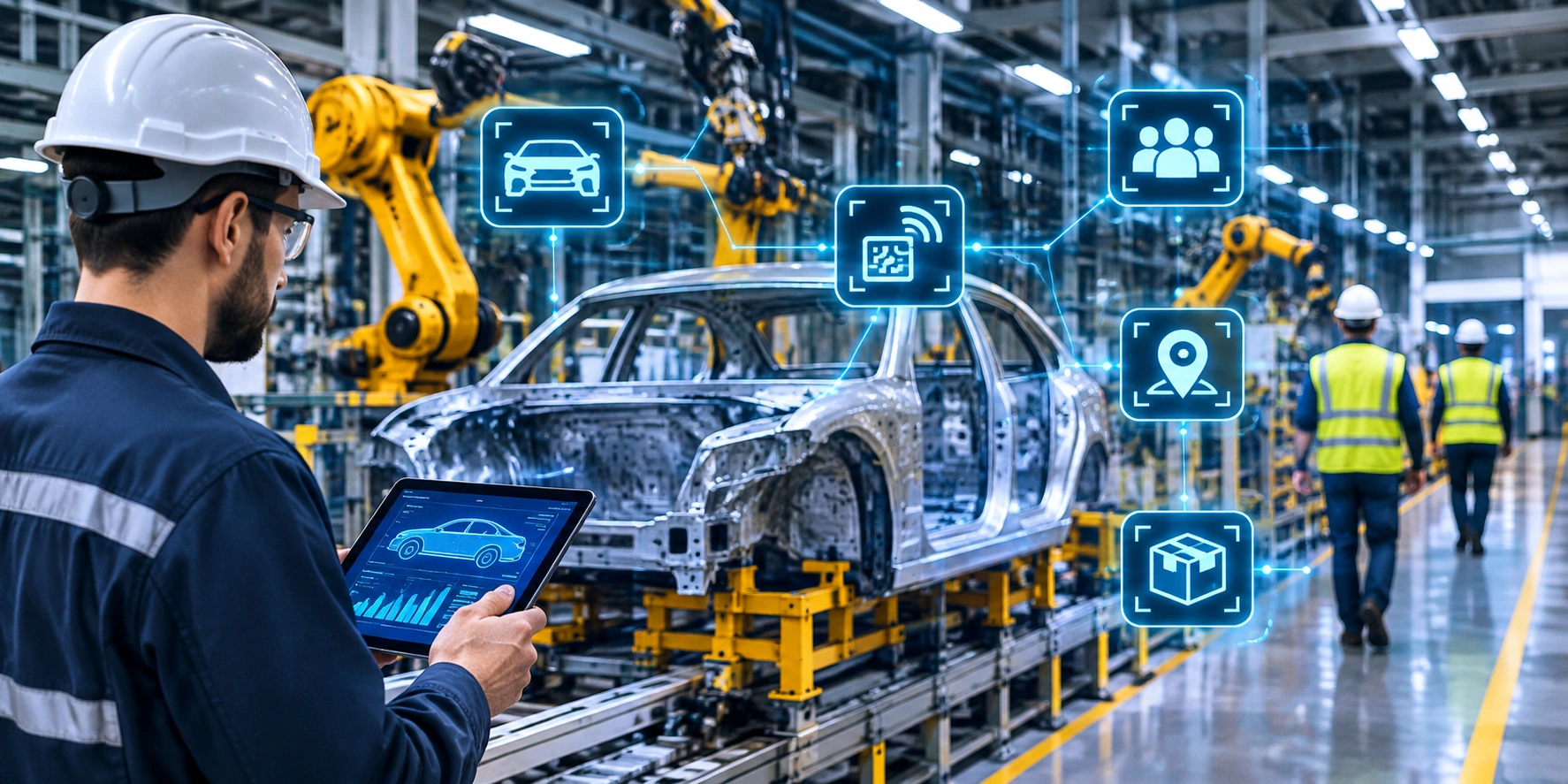
For OEM vehicle manufacturing, asset traceability and personnel visibility serve different operational purposes. Vehicle bodies, powertrain components, battery-related assemblies, racks, tooling, and material containers may require lifecycle or handover records. Personnel-location information may support controlled site access, workflow coordination, or emergency mustering. Each use case requires its own data model, operating rules, retention approach, and evaluation criteria.
OEMNex applies Physical AI and AIoT concepts to these workflows by connecting identification and sensing with event processing and operational systems. The implementation should be selected around the plant environment, required events, existing systems, and the level of location information the workflow actually needs.
Track the Right Asset or Person at the Right Production Event
A tracking workflow begins with a defined operational event. In an OEM vehicle plant, that may be a vehicle body entering a body shop zone, a component being transferred to a line-side supermarket, a rack being handed from material handling to production, a tool entering a controlled work area, or an authorized technician entering a designated zone. Each event should create a record that can be reconciled with the relevant manufacturing, inventory, maintenance, access, or safety process.
A practical event record can associate an identifier with a location or zone, timestamp, observation source, and business context. For example, a vehicle identification number (VIN) can be associated with a body-shop station and production status, while a component identifier can be associated with a batch, container, or vehicle build record. Personnel records should be handled separately where appropriate, with access limited to legitimate operational needs.
- Vehicle bodies and major assemblies: associate identity with production stage, transfer point, or destination.
- Components and material containers: record receipt, staging, movement, line-side delivery, and reconciliation events.
- Tools and production equipment: identify location, assignment, handover, or availability when the workflow requires it.
- Personnel: support site access, zone visibility, workflow coordination, or emergency mustering with appropriate privacy controls.
- Handover records: connect the sending location, receiving location, asset identity, timestamp, and exception status.
Select Identification Technology for the Plant Environment
No single identification technology is appropriate for every OEM vehicle manufacturing workflow. The selection should follow the information requirement first, then the physical environment, infrastructure, power, update frequency, installation constraints, and maintenance model.
RFID for Defined Read Events and Material Traceability
Radio frequency identification (RFID) can support repeatable identification at defined points such as receiving, staging, line-side replenishment, or transfer gates. Passive RFID can be useful when tags do not need their own battery, while active RFID can support applications requiring longer-range or more frequent observations. Metal structures, tag placement, reader configuration, and the physical geometry of a production area can affect performance, so plant-specific testing is required.
BLE for Flexible Location and Presence Applications
Bluetooth Low Energy (BLE) can support asset or personnel location workflows where battery-powered tags and installed beacons or receivers fit the operating model. BLE approaches vary significantly in how position is estimated. The appropriate design depends on whether the workflow needs zone-level presence, relative location, or more detailed positioning.
UWB for Higher-Resolution Location Workflows
Ultra-wideband (UWB) can support location workflows that require more detailed positioning than a simple read zone. In an automotive plant, candidate applications may include locating mobile equipment, high-value assets, or material-handling resources where position information can improve coordination. Anchor placement, site geometry, radio conditions, tag power, and calibration should be evaluated under representative operating conditions.
Vision for Context-Rich Observation
Computer vision can provide observations from cameras installed around production areas. It can help identify movement, occupancy, or other visible conditions when the environment and privacy requirements permit. Occlusion, lighting, camera placement, reflective surfaces, and changing production conditions can affect results. Vision should be treated as one sensing option rather than a universal replacement for tagged identification.
Process Tracking Events Before They Become Operational Records
Tracking systems rarely produce perfect event streams. A reader may miss an observation, a device may report the same event more than once, a timestamp may arrive late, or two observations may conflict. An effective event-processing layer should preserve the original observation, apply data-quality rules, and make the resulting status understandable to the users and systems that consume it.
- Missed reads: identify expected events that did not arrive and provide a defined reconciliation path.
- Duplicate events: detect repeated observations so one physical movement does not become multiple business transactions.
- Timestamp issues: preserve event time and ingestion time where needed so delayed connectivity does not obscure the actual sequence.
- Conflicting observations: flag inconsistent identity or location information for review rather than silently selecting an answer.
- Stale observations: distinguish a last-known location from a current confirmed observation.
- Business association: connect validated events to manufacturing execution, inventory, logistics, maintenance, access, or other approved records.
This distinction is important in vehicle manufacturing because a tracking event is not automatically proof that a production step was completed. A location observation can show that a vehicle body or component was seen in a zone. Additional production records or validated process signals may be needed to establish that an operation actually occurred.
Connect Traceability to Existing Manufacturing Workflows
Asset and people tracking delivers more value when its events can be reconciled with the systems already used by the plant. Depending on the workflow, relevant systems may include manufacturing execution systems (MES), enterprise resource planning (ERP), warehouse management systems (WMS), computerized maintenance management systems (CMMS), supervisory control and data acquisition (SCADA), access-control systems, or plant-specific applications.
Integration should define identifiers, event types, timestamps, status values, ownership, synchronization behavior, and handling for rejected or delayed records. For example, an asset movement event may need to associate a component identifier with a container, destination zone, work order, and production time window. The integration design should also specify what happens during network outages, duplicate messages, device maintenance, or system recovery.
For personnel tracking, governance is especially important. The system should define who can access location information, why the information is collected, how long it is retained, and which workflows are permitted to use it. Emergency mustering, controlled-area access, and operational coordination may have different requirements from workforce analytics. Tracking should not be treated as authorization to perform a physical action.
Design Personnel Tracking With Clear Operational and Privacy Boundaries
People tracking requires a different governance model from material traceability. A vehicle component may need a persistent lifecycle record, while a personnel location record may need limited access and shorter retention depending on its purpose. Before deployment, define the operational reason for collecting personnel-location information and establish the permitted users, retention period, and review process.
- Site access: use identity and zone observations only for defined access or security workflows.
- Emergency mustering: provide a clear method for determining last-known or confirmed presence while identifying uncertainty.
- Workflow coordination: use zone or presence information where it supports an authorized production task.
- Data access: restrict personnel information to approved roles and log relevant access.
- Retention: align storage periods with the documented operational purpose and applicable organizational requirements.
A tracking platform should also distinguish confirmed location from inferred or last-known location. This is particularly important during network interruptions, device failures, or areas with poor sensing coverage. Uncertainty should remain visible to the responsible user instead of being presented as false precision.
Measure Tracking Quality Before Expanding the Deployment
A pilot should test the complete workflow under representative automotive manufacturing conditions. The objective is to determine whether tracking events are sufficiently complete, timely, and maintainable for the operational decision being supported. A dashboard that looks accurate during a controlled demonstration is not enough evidence for production deployment.
- Event completeness: measure the proportion of expected asset or handover events that are captured and usable.
- False-event rate: measure observations that incorrectly associate an asset, person, or location with a workflow.
- Reconciliation time: measure how long users need to resolve missing, duplicate, conflicting, or delayed events.
- Location or association error: evaluate the level of uncertainty that matters for the selected workflow and operating zone.
- Maintenance effort: record tag replacement, battery servicing, reader or anchor maintenance, camera servicing, calibration, and other recurring work.
- Operational usefulness: determine whether the resulting information improves the defined workflow compared with the existing process.
Testing should include normal production, high traffic, equipment movement, occlusion, communication interruptions, missing observations, duplicate events, and recovery. Results should be compared with a baseline and documented with the conditions under which they were obtained.
Build a Tracking Architecture Around Identity, Events, and Evidence
A practical Physical AI and AIoT architecture can separate identification, sensing, event processing, business integration, and user workflows. Identification technologies produce observations. Edge or IoT software can collect and normalize those observations. Data services can preserve event history and quality information. Application and enterprise integrations can then expose the appropriate records to manufacturing, logistics, maintenance, safety, or other authorized users.
The architecture should make system boundaries explicit. Field devices, readers, cameras, gateways, edge computers, servers, enterprise applications, and user interfaces each have different operating responsibilities. Access control, logging, data retention, outage behavior, and device lifecycle management should be defined before production deployment.
OEMNex can use this solution pattern as a basis for discussing an OEM vehicle manufacturing use case, but the appropriate technology mix and capability status should be established through requirements assessment and pilot evaluation rather than assumed from the tracking concept alone.
Related OEMNex Resources
- Identification Engine
- IoT Software
- Identification and Sensing Hardware
- Asset Movement and Handover
- RFID vs BLE vs UWB
- Cybersecurity and Physical Action Safeguards
- Contact OEMNex