
Physical AI and AIoT Engines Architecture for OEM Vehicle Manufacturing
Explore data, decision, command, and feedback flows in OEMNex’s Physical AI and AIoT architecture for OEM vehicle manufacturing.
OEMNex’s Physical AI and Artificial Intelligence of Things (AIoT) architecture connects vehicle, component, equipment, and production data with operational decisions and, where authorized, physical action. For original equipment manufacturer (OEM) vehicle plants, the architecture can be applied to workflows such as component traceability, production-line condition monitoring, inspection support, and controlled equipment adjustments. The right design depends on the assets involved, the available data, plant systems, and the boundaries established for human and machine authority.
How the OEMNex Engine Architecture Is Organized
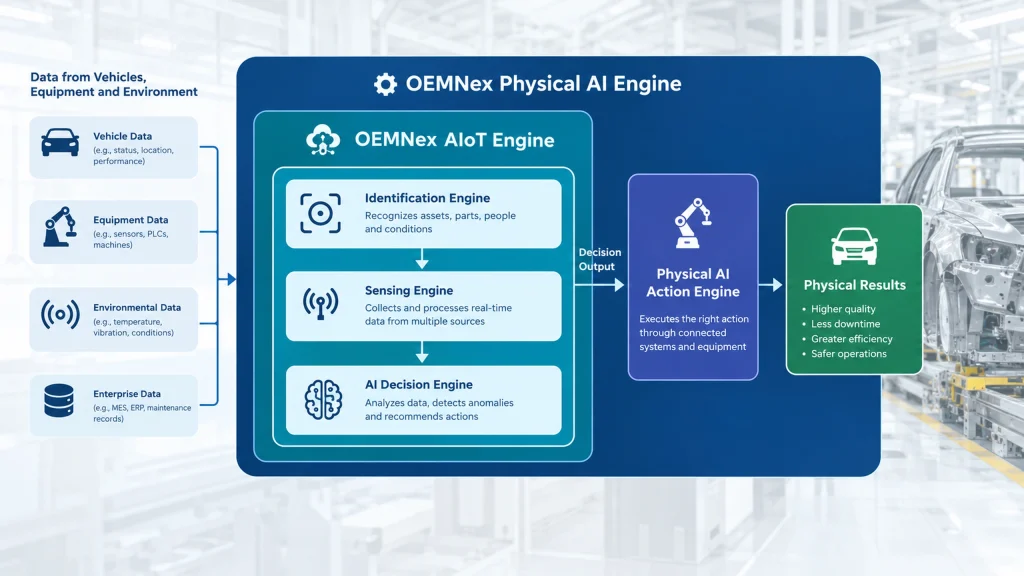
The architecture has two nested configurations. The OEMNex AIoT Engine™ groups identification, sensing, and AI-supported decision functions. The larger OEMNex Physical AI Engine™ includes that AIoT configuration and adds a Physical AI Action Engine for connecting approved decisions to operational execution. This separation makes clear that identifying an asset, measuring its condition, and recommending a response are different functions from issuing a command or confirming a physical result.
Identification Engine
The Identification Engine associates observations with the correct vehicle, component, tool, work in progress, or production asset. Depending on the use case, inputs may include identifier reads, location observations, and movement or custody events. Data processing should account for missed reads, duplicate events, stale timestamps, and uncertain associations before downstream functions rely on an identity record.
Sensing Engine
The Sensing Engine captures physical and operating conditions relevant to the selected workflow. Examples in vehicle manufacturing include equipment vibration and temperature, electrical measurements, machine states, and inspection images. Readings need suitable units, timestamps, operating context, and quality indicators. Missing data, sensor drift, calibration limits, and changes in production mode should be visible to downstream processing rather than treated as reliable measurements.
AI Decision Engine
The AI Decision Engine evaluates identity and condition information alongside relevant production context and business rules. Depending on the application and evidence available, it may support anomaly detection, quality review, maintenance prioritization, or operational recommendations. Each output should identify its input context, decision or model version, uncertainty where applicable, and the conditions under which it should be reviewed, rejected, or escalated. When data are stale or conditions fall outside evaluated limits, the workflow should allow the system to abstain or request human review.
Physical AI Action Engine
The Physical AI Action Engine sits within the larger Physical AI architecture but outside the AIoT Engine. It provides the distinct action path for an approved decision to reach an equipment interface, controller, actuator, or other authorized operational system. Before dispatch, the workflow should validate the target, permissions, operating limits, and required approvals. Human-mediated, human-approved, and bounded autonomous execution are different operating modes and should be specified explicitly.
Data, Decision, Command, and Feedback Paths
A useful implementation keeps observation, decision, command, and outcome records distinct. Identification events and sensor readings form the observation path. The AI Decision Engine produces a recommendation or decision output. If the action is permitted, the Physical AI Action Engine validates and dispatches a command through the relevant interface. A command acknowledgment confirms receipt or processing, not necessarily that the intended physical change occurred. Independent evidence, such as a subsequent sensor reading, equipment state, or verified position, is needed to assess the result.
For example, a production-line condition alert might lead to a maintenance review rather than an immediate machine command. In a separate, engineered workflow, an approved adjustment could be sent to a compatible control interface after required interlocks and permissions are checked. The appropriate response depends on the equipment, validated control design, and plant procedures; the architecture alone does not establish that a particular interface or action is supported.
Integration and Operational Boundaries
A plant implementation may need to exchange information with manufacturing execution systems (MES), enterprise resource planning (ERP) systems, maintenance records, quality applications, programmable logic controllers (PLCs), gateways, and edge or server services. The specific interfaces must be selected and tested for the target environment. Do not assume that every protocol, controller, enterprise application, or deployment model is compatible without verification.
Define the system boundary before deployment: which field devices provide data, where processing occurs, which users review decisions, which system owns each record, and which components can issue commands. Timing requirements, network availability, data retention, cybersecurity controls, access permissions, and recovery behavior should be addressed during design. Human override and independent protective functions must remain clear wherever physical action is possible.
Data Contract and Traceability
A shared data contract helps maintain traceability across components. A representative record can include asset_id, event_time, ingestion_time, value and unit, quality_flag, model_version, decision_id, command_id, and observed_outcome. The fields and definitions should be tailored to the selected workflow. Define time-zone handling, event ordering, identifier rules, duplicate handling, missing-value conventions, and data ownership. Keep the observation, decision, command, and independently observed outcome linked but separately recorded.
Validation Before Production Use
Evaluate the architecture against a defined baseline and representative operating conditions before relying on it in production. Useful measures may include traceability event completeness, false or duplicate associations, sensor data availability, alert usefulness, decision review workload, command rejection rate, response time, and the proportion of attempted eligible actions with independently verified outcomes. Set acceptance criteria with the plant’s engineering, operations, IT, quality, and safety stakeholders. Test degraded conditions such as delayed messages, unavailable networks, stale observations, denied commands, failed execution, and manual override.
Explore the Engine Components
- Identification Engine
- Sensing Engine
- AI Decision Engine
- Physical AI Action Engine
- System Integration and Deployment
- System Integration Guide