
Connect Authorized Decisions to Factory Equipment
In OEM vehicle manufacturing, physical action can mean positioning a body-in-white fixture, adjusting a conveyor, triggering a validated inspection sequence, or requesting a bounded machine adjustment. Connecting an AI-supported decision to that action requires more than sending a command. The equipment interface must identify the target, check authorization and operating conditions, report its state, and provide evidence of the resulting physical outcome.
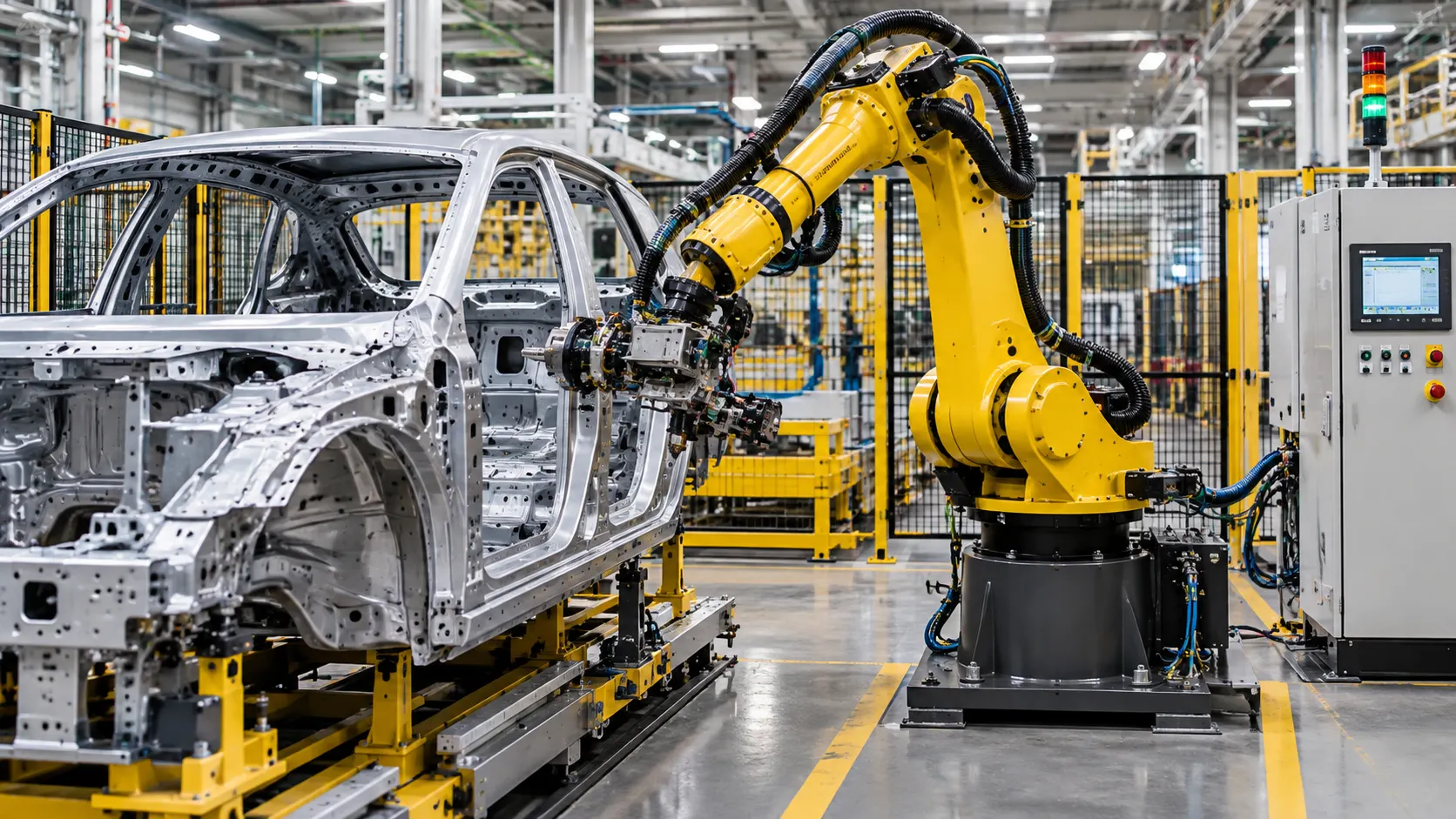
OEMNex focuses on Physical AI and Artificial Intelligence of Things (AIoT) technologies and applications for vehicle manufacturing. The technologies described here are implementation options to evaluate against a plant’s actual controls, equipment, and operating requirements. Compatibility or deployment readiness should be confirmed for each proposed interface.
Control Technologies Across the Automotive Production Line
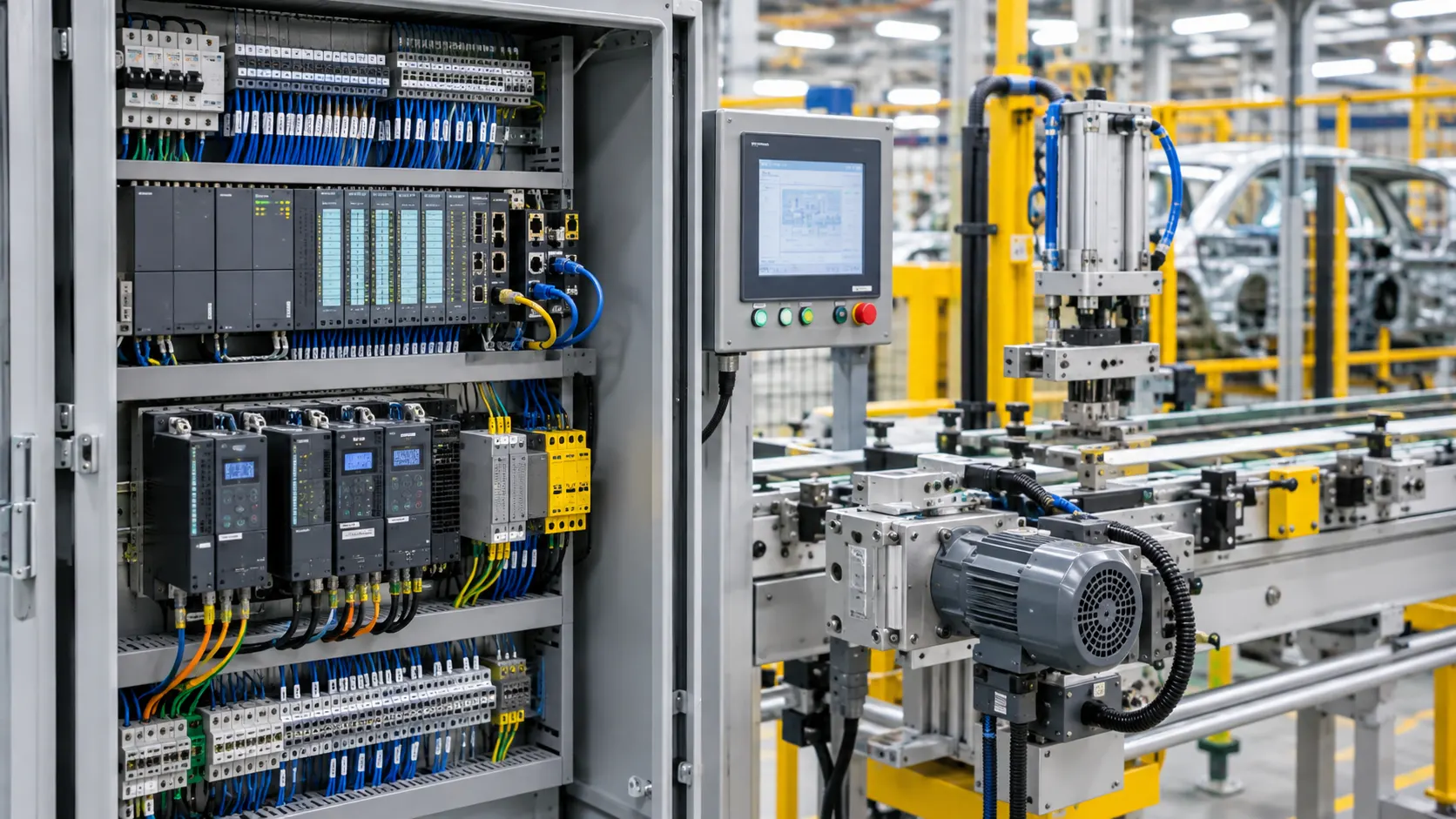
A vehicle assembly facility may combine programmable logic controllers (PLCs), industrial motion controllers, variable frequency drives, servo drives, electric and pneumatic actuators, conveyor systems, and industrial robots. These components serve different purposes. Controllers coordinate defined machine sequences, drives regulate motor operation, actuators create movement, and robotic systems perform programmed tasks such as handling, fastening, dispensing, or welding.
An AI application may recommend a change, request an approved operation, or provide context to an existing automation system. The appropriate connection depends on the equipment owner’s control architecture and on the consequences of an incorrect or delayed action. A recommendation or workflow request should not be described as direct equipment control unless an implemented and validated command path actually exists.
Define the Command and Feedback Interface
Before connecting an AI-supported decision to machinery, define the command contract between the supervisory application and the equipment control layer. The contract should specify the target asset, requested operation, permitted operating mode, authorization source, command identifier, timeout, acknowledgment behavior, and expected completion state. It should also define how rejected, duplicate, stale, or out-of-sequence requests are handled.
Commands and acknowledgments are not the same as proof that an action completed. A controller may acknowledge receipt while a mechanical obstruction, drive fault, interlock, or downstream condition prevents the intended result. Where the workflow requires confirmation, use independent evidence such as a position sensor, machine-state signal, inspection result, or other appropriate observation of the physical state.
Timing must be defined at both levels. Supervisory software may request a production step or set a bounded target, while the local controller executes the deterministic, time-sensitive control loop. AI should not be assumed to replace low-level motion control, synchronization, or validated machine sequencing.
Keep AI Decisions Separate from Equipment Protection
AI analysis and supervisory logic should remain distinct from validated equipment-control functions and independent protective systems. Depending on the machine and its risk assessment, these protections may include safety-rated interlocks, guarding, emergency stops, safe motion functions, and defined manual operating modes. The specific design must be established by the responsible engineering and safety teams; this page does not prescribe universal settings or certify a particular installation.
The integration design should define who or what can authorize an action, which conditions must be true before execution, how an operator can stop or override the process, and what happens after a fault. If authorization fails, required state information is stale, or communication is lost, the system should follow a reviewed response that prevents an unapproved command from being treated as successful. Recovery behavior should be tested rather than assumed.
Evaluate Fit for OEM Manufacturing Equipment
Technology selection should start with the physical task and the equipment boundary, not with a preferred protocol or device. Review the machine’s controller and drive interfaces, required response time, operating modes, available state signals, network conditions, maintenance access, and plant change-control process. Confirm the integration method with the equipment and controls owners before making a compatibility commitment.
- Equipment and task: identify the robot, conveyor, fixture, press, fastening station, or other asset and the precise action under consideration.
- Command and state data: document asset identifiers, command parameters, state codes, timestamps, units, acknowledgment rules, and error conditions.
- Authority and safeguards: identify approval roles, interlocks, manual control, independent protective functions, and stop or override behavior.
- Failure handling: test denied authorization, unavailable devices, delayed messages, duplicate commands, controller faults, and communication loss.
- Verification: define what independent signal or inspection confirms the physical result, and how an incomplete or uncertain outcome is recorded.
- Commissioning evidence: record test conditions, acceptance criteria, unresolved limitations, rollback steps, and the engineering approval required before production use.
Commission and Verify the Physical Outcome
Commissioning should verify the complete sequence from request to observed result. A practical test plan can include a valid command, a rejected command, a timeout, a communications interruption, a device fault, and a manual override. For each case, record the expected response, actual equipment state, acknowledgment and event timestamps, and whether the workflow recovered as designed.
Evaluate operational performance alongside control integrity. Relevant measures may include command completion rate, rejected or timed-out requests, time to detect an unsuccessful action, frequency of operator intervention, recovery time, and the proportion of outcomes confirmed by independent state evidence. Define each metric’s denominator and test conditions before comparing results.
A software demonstration can show data flow or simulated command handling, but it does not establish that a real machine can be operated safely. Production use requires site-specific engineering review, interface testing, commissioning evidence, and approval by the responsible plant teams.
Plan the Integration with OEMNex
A focused discussion can begin with one bounded manufacturing workflow, the equipment involved, the current control sequence, available state data, and the decision or action being considered. From there, the teams can identify interface dependencies, authorization requirements, failure cases, and the evidence needed to evaluate a proposed implementation.
Explore the Physical AI Action Engine for the action path and outcome feedback. Review system integration and deployment for interfaces, data exchange, and deployment considerations.