
Distributed Intelligence for Robots, Drones, and Autonomous Vehicles in Automotive Manufacturing
Robots, drones, and autonomous vehicles must connect perception with bounded decisions and physical execution.
In original equipment manufacturer (OEM) vehicle production, research into distributed intelligence can help examine how mobile robots move components, robotic systems support assembly, and inspection platforms gather useful information without disrupting production. The central questions are how these systems coordinate, how they respond when conditions change, and how teams verify that a task was completed as intended.
Research Priorities for Automotive Production
Automotive plants combine fixed automation, mobile equipment, production schedules, constrained aisles, shared workspaces, and quality requirements. A robot or autonomous mobile robot (AMR) may need to deliver parts to a work cell while production demand changes or another vehicle occupies a planned route. An inspection drone may need to adjust its path around overhead equipment and still collect images that are useful for maintenance review. Research should begin with a specific workflow, the equipment involved, and the operational decision the system is expected to support.
A key research question is which decisions should run locally on a robot or edge computer and which should be coordinated across a fleet or plant system. Local processing can support timely responses to nearby obstacles or sensor changes, while shared scheduling can account for task priorities, aisle availability, charging, and production demand. The design must also define what happens when communications are delayed or lost, a sensor becomes unreliable, or a task cannot be completed safely.
Coordinating Mobile Robots and Material Handling
A relevant research path is coordinated material transfer between parts supermarkets, kitting areas, assembly cells, and other approved destinations. The study can compare a fixed dispatch policy with an adaptive policy that considers vehicle availability, task urgency, route conflicts, battery state, and changing production demand. Candidate methods may include multi-agent scheduling, route planning, local obstacle avoidance, and edge-based exception handling. These are research options, not claims of currently deployed OEMNex capabilities.
The proposed demonstration should define the facility layout, vehicle capabilities, payload limits, travel rules, task queue, handoff points, and baseline dispatch logic. Simulation can introduce blocked aisles, delayed messages, unavailable vehicles, and changing priorities. Where appropriate, a controlled demonstration can then test selected behaviors with a defined safety boundary and operator oversight.
Robotic Assembly and Human-Robot Collaboration
Robotic assembly and machine-tool assistance raise questions about adaptive manipulation, repeatability, and safe operation in shared workspaces. Research may examine whether a robot can adjust a grasp or motion plan when part position, presentation, or availability differs from the expected condition. It should also consider how a worker can pause, redirect, or recover a task and how the system communicates uncertainty before acting.
Candidate methods include perception-guided manipulation, task adaptation, and learning approaches evaluated across representative parts and operating conditions. Transfer from one task or station to another should not be assumed. The evaluation should identify which geometries, fixtures, tools, and conditions were included, and whether a method generalizes beyond the cases used for tuning.
Drone Perception and Inspection Mission Planning
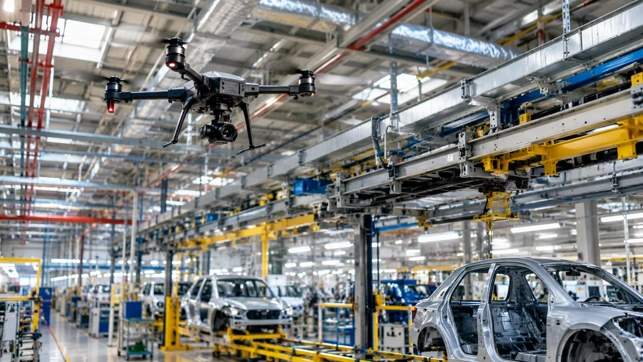
A drone can be considered for selected inspection or active-survey tasks in automotive facilities, such as gathering visual records of overhead infrastructure or reaching inspection viewpoints that are difficult to access during normal operations. Research questions include localization in visually repetitive spaces, obstacle avoidance around beams and conveyors, camera coverage, route adaptation, and reliable return or landing when a mission is interrupted. Site rules, airspace restrictions, people, moving equipment, and production continuity must define the operating boundary.
A proposed demonstration can compare a fixed inspection route with an adaptive mission planner in simulation. The scenario should model occlusions, changed access conditions, localization degradation, low battery, and temporary route blockage. If a controlled flight test is appropriate, it should be separately approved and evaluated under site-specific procedures. Navigation performance and inspection quality must be measured separately: reaching a viewpoint does not establish that an image reveals the condition of interest.
Demonstration Design and Evaluation
Begin with one platform and one automotive manufacturing task, such as AMR material transfer or drone inspection of overhead infrastructure. Document the operating boundary, baseline workflow, available data, system interfaces, constraints, and intended users before selecting a method. Compare fixed and adaptive policies under matched conditions in simulation, then proceed to a controlled physical demonstration only when equipment, site procedures, and safeguards are suitable.
Evaluation should include the measures relevant to the selected task:
Task completion rate and time to complete, with failed or incomplete tasks reported.
Route or inspection coverage, transfer accuracy, and localization error, as applicable.
Energy use and resource utilization, including charging or replenishment where relevant.
Constraint violations, blocked routes, rejected commands, and operator interventions.
Recovery time after communications loss, sensor degradation, changed routes, or unavailable equipment.
For inspection tasks, image coverage and inspection quality measured independently from navigation performance.
Report baselines, scenario assumptions, run counts, variability, and adverse outcomes. Synthetic simulation results can help compare methods under controlled assumptions, but they do not establish field performance, safety certification, production readiness, or customer outcomes. A physical test should record the equipment configuration, software and model versions, operating conditions, safety controls, and observed results.
Related Research and Technical Resources
Explore the research hub for related research programs and their current publication status.
Discuss an Automotive Robotics Research Question
Discuss a specific material-transfer, inspection, or autonomous-vehicle workflow with the OEMNex team. A useful technical discussion starts with the target task, operating environment, available equipment and data, system interfaces, constraints, and the evidence needed to judge the approach.