
Industrial Digital Twins and Simulation for OEM Vehicle Manufacturing
Simulation can help automotive manufacturers examine production decisions before changing physical equipment or disrupting a vehicle assembly line. OEMNex research in Physical AI and Artificial Intelligence of Things (AIoT) considers how digital models of body-in-white cells, robotic assembly, conveyors, material flow, and connected equipment can be aligned with operational observations and evaluated for specific decisions.
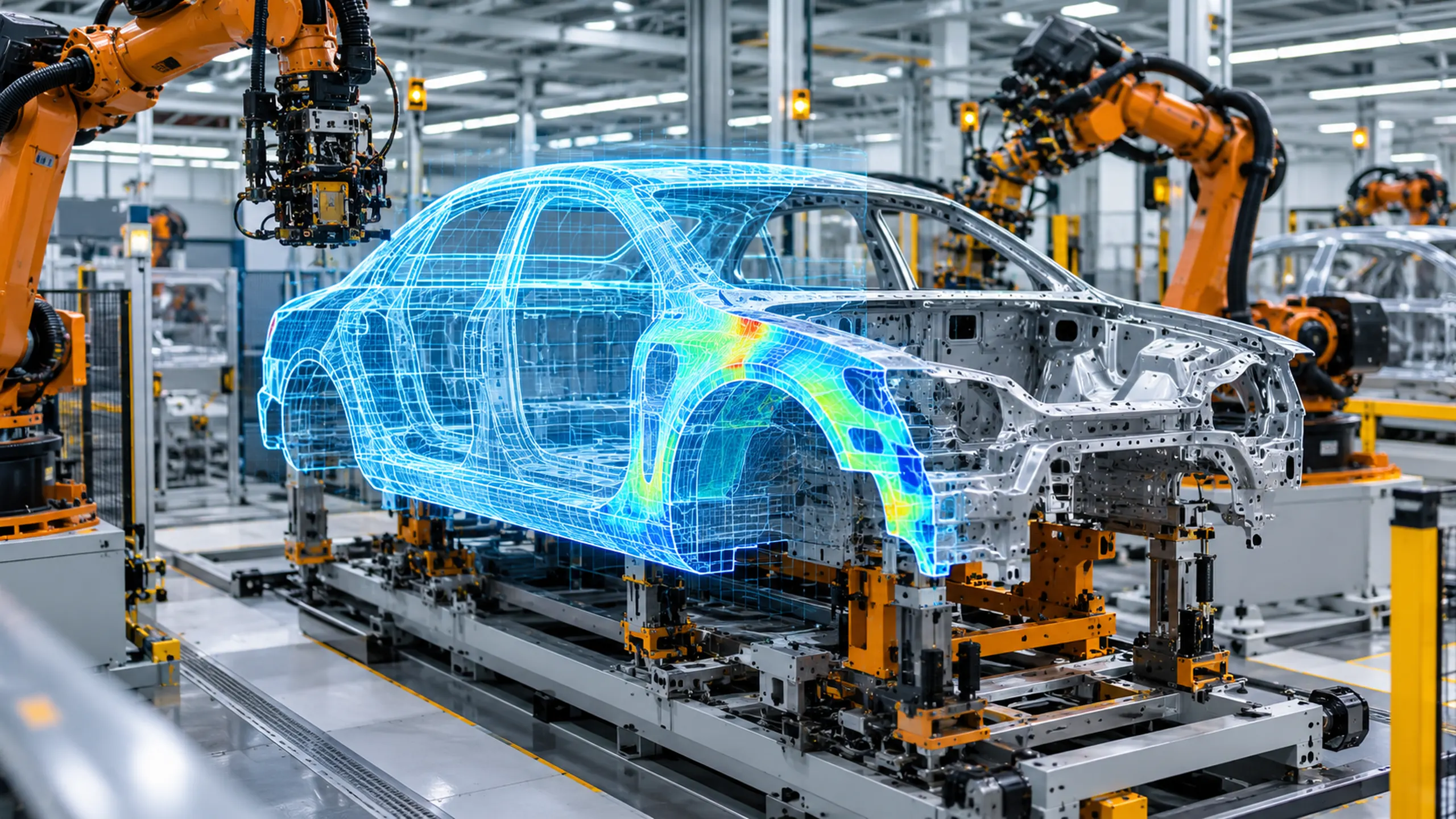
The objective is not simply to create a visual replica of a factory. A useful operational digital twin must represent the states and constraints that matter to a defined task, make its uncertainty visible, and be tested against physical observations before its predictions guide production decisions.
Digital Twins for Production State and Action Evaluation
Vehicle manufacturing combines tightly coupled stations, robot cycles, fixtures, conveyors, quality checks, and material availability. A delay or equipment-state change at one station can affect downstream queues, work in progress, and line balance. A digital twin can provide a structured way to estimate operational state, compare candidate schedules or equipment actions, and identify where model assumptions may change a recommendation.
Research questions include how closely a model must predict a specific production state to support a decision, how quickly observations must be synchronized, and how to distinguish genuine equipment changes from sensor faults or incomplete data. Candidate inputs include controller and machine events, station cycle times, robot and conveyor states, quality inspection records, and maintenance history, subject to data availability and authorization.
The modeled boundary should be explicit. It may cover a single robotic cell, a sequence of assembly stations, or a bounded production-flow segment. The model should document cycle-time distributions, changeovers, equipment availability, resource contention, shift patterns, and operating constraints rather than assume idealized production.
Simulation-to-Reality Transfer and Synthetic Data
Simulation can generate controlled variations that are difficult to capture consistently on a production line, including unusual part presentation, changing lighting, sensor drift, missing observations, communication delays, and equipment degradation. These scenarios can help researchers stress-test perception, inspection, scheduling, or decision methods. Synthetic data must remain distinguishable from real production records, and evaluation data should be held separate from the data used to develop or tune a method.
A simulator can also teach the wrong pattern if its geometry, sensor behavior, timing, or environmental variation differs from the plant. Research should therefore document the gap between simulated and physical conditions, test for shortcuts in learned models, and evaluate on untouched physical examples when authorized data and test facilities are available. Where no physical reference data exists, the model should be described as assumption-based and plausibility-reviewed, with physical validation still pending.
Hardware-in-the-Loop Testing for Industrial Controls
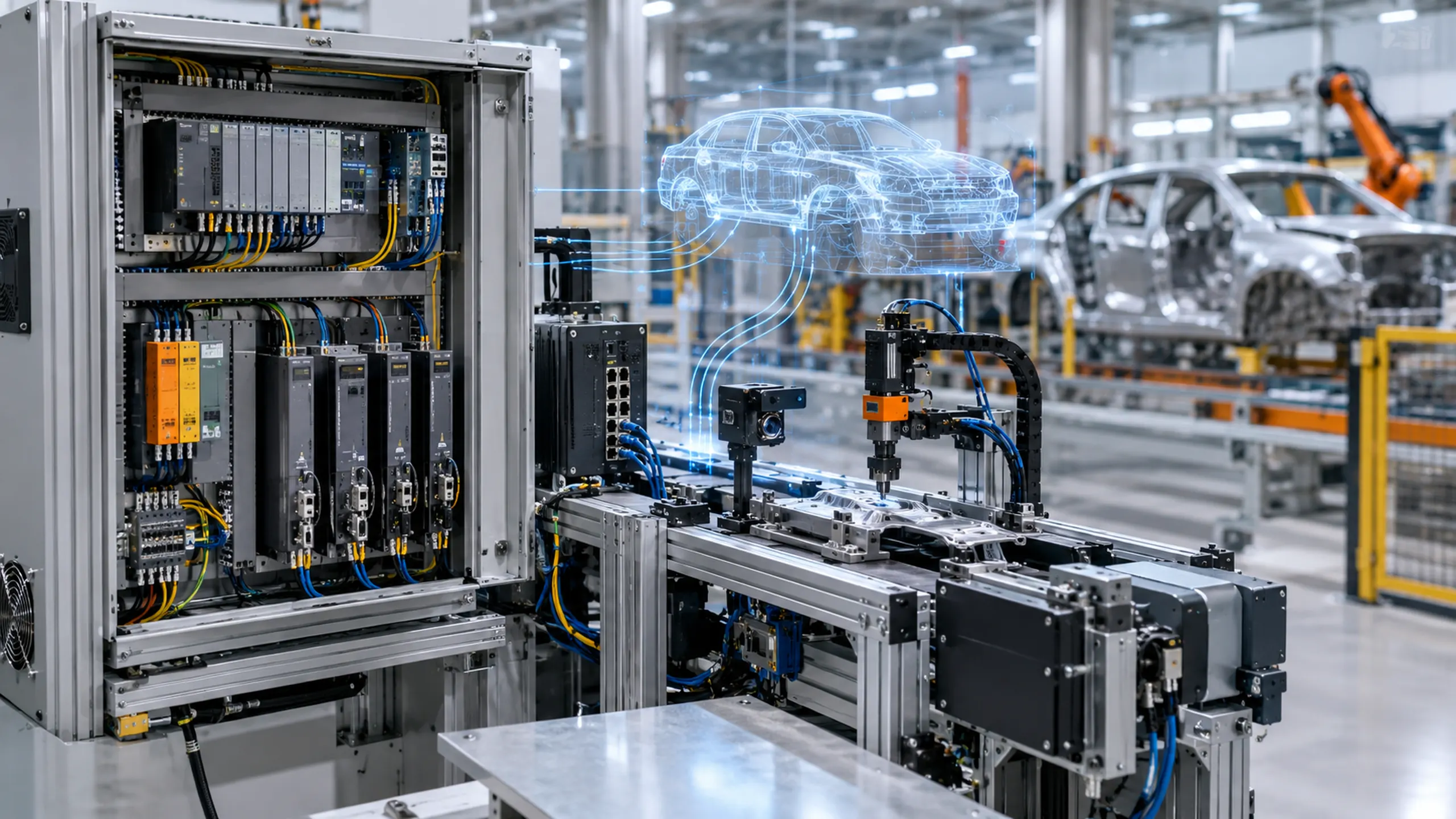
Hardware-in-the-loop testing connects real controllers, gateways, or other selected hardware to a simulated process. In automotive manufacturing, this approach can help investigate timing behavior, protocol handling, command rejection, and recovery logic without immediately exposing production equipment to every test condition. Scenarios may include stale sensor values, delayed or reordered messages, communication loss, conflicting requests, and partial execution.
A proposed demonstration would run a versioned scenario set against a process simulator and compare the simulated process state with signals from the connected hardware. Test coverage should be tied to defined requirements and failure conditions. A successful software or bench test does not establish that an installation is safe for production; commissioning and site-specific validation remain necessary.
Counterfactual Production Experiments and World Models
Counterfactual experiments compare what may happen under different operating choices while keeping the modeled demand and disturbance conditions comparable. For production flow, discrete-event simulation can represent queues, changeovers, constrained resources, and material availability. Candidate scheduling or allocation policies can then be compared with a credible baseline before any limited, supervised trial is considered.
Research may also examine industrial world models that predict how candidate actions affect a physical process. These learned models should be compared with physics-based twins and hybrid approaches, with attention to prediction horizon, compounding error, rare events, uncertainty calibration, and the ability to recognize conditions outside the validated range. A model should not be treated as decision-ready merely because it produces a plausible animation or forecast.
How Digital Twin and Simulation Methods Should Be Evaluated
Evaluation begins with a defined operational question, a documented model boundary, and a credible baseline. The test plan should specify the source and quality of each input, the operating conditions represented, the assumptions that matter most, and the criteria for deciding whether the model is useful for its intended task.
- State and outcome prediction error: Compare predicted machine, station, queue, or process states with held-out observations and define the measurement window and units.
- Synchronization delay and model mismatch: Measure the lag between physical events and model updates, and record how errors change as equipment or operating conditions change.
- Scenario coverage: Track normal production, rare but credible events, and degraded conditions such as sensor faults or communication interruptions.
- Transfer degradation: Compare performance on synthetic or simulated cases with performance on separate physical test data, where available.
- Decision usefulness: Compare candidate decisions with a simple or existing baseline and include infeasible choices, adverse outcomes, and constraint violations.
- Computational cost: Record execution time and computing requirements for the selected model and evaluation workload.
Use repeatable configurations, fixed random seeds, versioned datasets and models, saved run logs, and sensitivity tests for influential assumptions. Report variability across independent runs. Do not present assumed inputs as measured facts, and do not claim reduced downtime, higher throughput, or cost savings unless the relevant outcome has been calculated and the causal assumptions are explicit.
Discuss a Digital Twin or Simulation Research Question
If your team is evaluating a digital twin for a vehicle assembly cell, robotic workcell, or production-flow problem, start with a specific decision the model needs to support. Useful scoping inputs include the equipment boundary, available controller and event data, operating modes, known disturbances, current decision process, and the physical checks needed to validate predictions.
Discuss your application with OEMNex