
Physical AI and AIoT Applications for OEM Vehicle Manufacturing
Automotive manufacturing depends on coordinated production equipment, accurate product records, consistent quality checks, and timely responses to changing operating conditions. Physical AI and Artificial Intelligence of Things (AIoT) connect information from vehicles, components, machines, and production processes with decisions that manufacturing teams can review and act on. OEMNex explores application pathways for vehicle assembly plants and their production workflows. The appropriate design depends on the equipment involved, the operating environment, available data, existing manufacturing systems, and the authority required for any physical response.
Contact OEMNex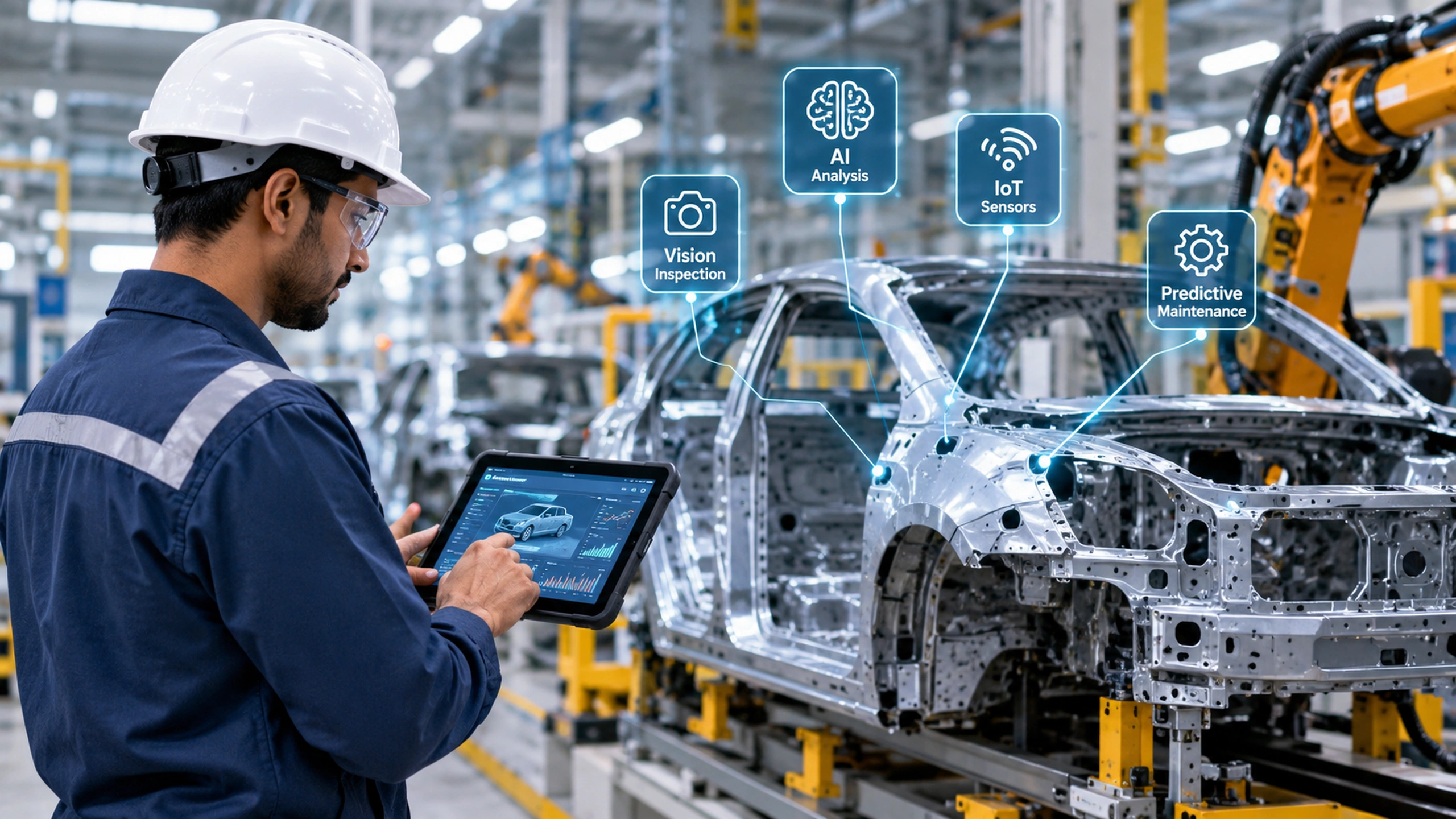
Physical AI and AIoT Applications for Automotive OEM Manufacturing
OEMNex explores application pathways for vehicle assembly plants and their production workflows. The appropriate design depends on the equipment involved, the operating environment, available data, existing manufacturing systems, and the authority required for any physical response.
Applications Across the Vehicle Production Lifecycle
Application opportunities can be organized around production assets, process stages, and vehicle lifecycle checkpoints. Examples include body-in-white, paint, powertrain or battery assembly where applicable, final assembly, end-of-line inspection, and material handoffs. Each setting has different identification, measurement, timing, quality, and integration requirements.
Vehicle, Component, and Material Traceability
Automotive plants need to associate the right vehicle, component, tool, or material with the right production event. Identification technologies such as barcode, RFID, Bluetooth Low Energy (BLE), ultra-wideband (UWB), or machine vision may support selected checkpoints, depending on line layout and environmental conditions. Event processing can connect observations with vehicle build records, work orders, and material genealogy while flagging missed reads, duplicate events, stale timestamps, or uncertain associations for review.
Equipment and Process Condition Monitoring
Sensors and inspection systems can provide information about equipment and process conditions, including vibration, temperature, pressure, electrical behavior, cycle timing, or visual characteristics. Context matters: readings should be associated with asset identity, operating mode, time, and data-quality status. AI-supported analysis may help surface deviations for maintenance, process, or quality teams, but alert thresholds and model performance require evaluation against representative plant conditions.
Inspection and Quality Workflows
At selected manufacturing checkpoints, vision or other sensing methods may assist with tasks such as component-presence checks, surface-condition review, assembly verification, or inspection-record association. The workflow should define defect classes, acceptance criteria, review responsibilities, and the handling of uncertain findings. False accepts, false rejects, missed defects, and review workload are important evaluation measures.
Authorized Physical Action and Outcome Verification
Some applications may connect a reviewed decision to a bounded equipment response, such as requesting a line-side intervention, dispatching an inspection, or issuing an authorized command through an approved interface. The design must define the target, permissions, operating limits, interlocks, fallback behavior, and human oversight. A command acknowledgment alone does not prove that the intended physical result occurred; follow-up sensor or equipment-state evidence is needed to verify outcomes.
How the Application Functions Fit Together
A typical workflow links four functions: identify the vehicle, component, or asset; sense its condition or the surrounding process; analyze the observations to support a decision; and, where authorized, connect that decision to a physical response. AIoT applications may stop at monitoring or decision support. Physical AI applications add a defined action path and feedback from the resulting physical state.
Evaluate an Application in Its Operating Context
A practical evaluation begins with a clearly bounded workflow and a credible baseline. Teams should identify the assets and production stages in scope, available data sources, operating modes, relevant interfaces, and the people responsible for responding. Evaluation measures may include event completeness, association errors, detection delay, false-alert rate, inspection performance, reconciliation time, maintenance effort, rejected commands, and independently verified outcomes.
Deployment requirements vary by plant. Integration with manufacturing execution, enterprise resource planning, quality, maintenance, or equipment-control systems should be assessed individually. Connectivity, data ownership, cybersecurity, installation, commissioning, and support responsibilities must be reviewed before an application is considered production-ready. No particular device, protocol, connector, or control strategy should be assumed compatible without validation.
Explore Application Scenarios
Explore application scenarios for automotive OEM manufacturing, including identification and traceability, equipment and process monitoring, and authorized physical action. Each scenario should state its operating setting, problem, relevant engine functions, evidence status, and evaluation question.
Simulation-Based Case Studies use synthetic data from modeled operating environments. They illustrate proposed approaches and do not report actual customer deployments. Results depend on stated assumptions and require validation with site-specific data.
Discuss Your Application
Discuss a vehicle manufacturing workflow with OEMNex. Share the equipment or process in scope, the operational question, available observations, existing systems, and the outcome your team needs to assess.