
RFID vs BLE vs UWB for OEM Vehicle Manufacturing
The right identification or location technology for an automotive OEM plant depends on what must be known about a vehicle, component, tool, container, or person and how that information will be used. RFID, Bluetooth Low Energy (BLE), and Ultra-Wideband (UWB) can all support manufacturing visibility, but they solve different problems. A useful selection starts with the required event, location detail, update frequency, operating environment, power model, infrastructure, maintenance effort, and integration requirements.
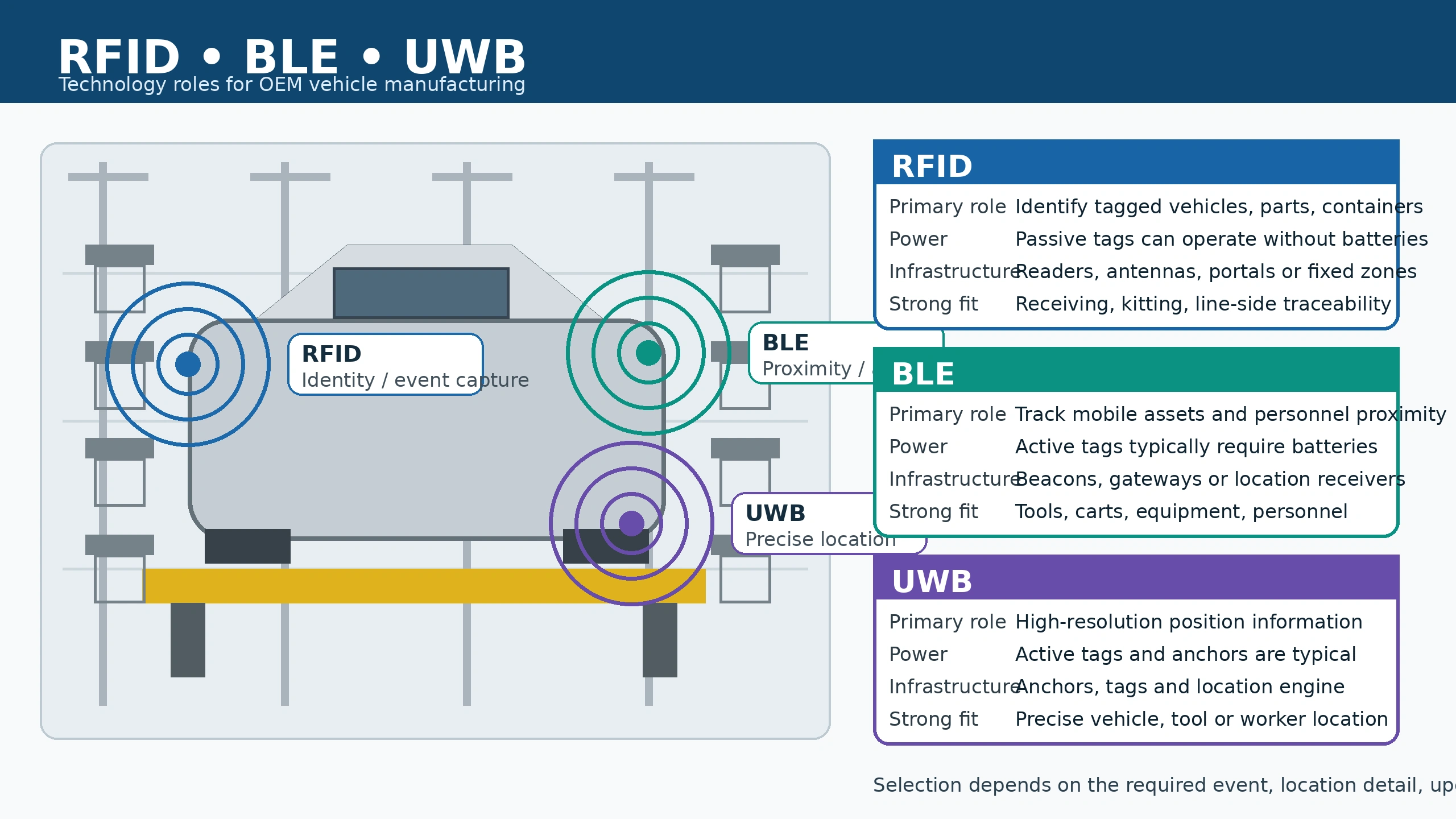
How Should Automotive OEMs Choose Between RFID, BLE, and UWB?
There is no universal winner. Passive RFID is often well suited to identifying tagged parts, containers, fixtures, and vehicle bodies at defined read points. BLE is useful when battery-powered tags need to provide recurring proximity or location information for mobile equipment, tools, carts, and personnel. UWB is appropriate when the operation requires more detailed real-time position information and can support the additional anchors, tags, power, calibration, and site infrastructure.
The first question should be operational rather than technological: what event or position must the plant know? Receiving may require confirmation that a tagged component or container passed a portal. A line-side process may require knowing which kit or fixture is associated with a vehicle. Tool control may require recurring location updates. A production engineering workflow may require more precise position information for a vehicle body, cart, or mobile tool. These requirements lead to different technology choices.
RFID, BLE, and UWB: What Each Technology Provides
RFID for Vehicle, Part, Container, and Fixture Identification
Radio Frequency Identification (RFID) uses tags and readers to associate a physical object with an identifier. Passive RFID tags can operate without a battery, making them useful for high-volume identification of automotive parts, returnable containers, racks, fixtures, and other items that pass defined reading zones. Active RFID can provide longer-range or recurring observations when a battery-powered tag is appropriate.
For OEM vehicle manufacturing, RFID is particularly useful when the business record needs to answer questions such as which component container arrived, which fixture entered a production zone, which vehicle body was associated with a station event, or whether a material handover occurred. Read performance depends on tag selection, reader placement, antenna configuration, materials, orientation, interference, and the physical geometry of the production environment.
BLE for Proximity, Mobile Assets, and Recurring Visibility
Bluetooth Low Energy (BLE) supports low-power wireless devices and can be used for proximity or location systems. Automotive plants can use BLE tags on tools, carts, material-handling equipment, production equipment, and other mobile assets. Battery-powered BLE tags can also support personnel-location use cases where organizational policies, privacy requirements, and operating procedures permit them.
BLE location behavior depends on the selected positioning method and the installed receivers, gateways, beacons, or anchors. Signal conditions can change around metal structures, vehicles, machinery, racks, and dense production areas. A plant should therefore evaluate actual placement and update requirements instead of relying on a nominal range value.
UWB for More Detailed Position Information
Ultra-Wideband (UWB) systems use tagged objects and fixed infrastructure to estimate position with high spatial resolution when the site is designed and calibrated for the intended use. UWB can be considered for applications such as precise vehicle-body location, tool positioning, controlled movement of carts, or other workflows where zone-level identification is not enough.
UWB normally requires more dedicated infrastructure than a simple RFID read point. Anchor placement, tag power, line-of-sight conditions, reflections, installation geometry, calibration, and location-engine performance can affect results. Site testing should establish the actual performance needed for the workflow rather than treating a published accuracy figure as a plant-wide guarantee.
Comparison Matrix for Automotive OEM Manufacturing
| Criterion | RFID | BLE | UWB |
|---|---|---|---|
| Primary information | Object identity and read events | Proximity or recurring location | Detailed position information |
| Typical tag power model | Passive or active | Usually battery-powered for location | Usually battery-powered |
| Infrastructure | Readers, antennas, portals or zones | Beacons, gateways or receivers | Anchors, tags and location receivers |
| Best-fit workflows | Receiving, kitting, traceability, handover | Tools, carts, equipment, personnel proximity | Precise vehicle, tool or movement location |
| Environment considerations | Metal, liquids, orientation, read-zone design | Metal, obstructions, receiver placement, battery life | Multipath, anchor geometry, calibration, obstruction |
| Update requirement | Event-based or scheduled reads | Recurring updates as needed | Frequent location updates when required |
| Key cost drivers | Tags, readers, antennas, installation and integration | Tags, receivers, batteries and maintenance | Tags, anchors, installation, calibration and maintenance |
| Main selection question | What object or event must be identified? | Which mobile object or person needs recurring visibility? | How precisely must the position be known? |
Automotive OEM Workflow 1: Material Receiving and Line-Side Traceability
A receiving workflow normally needs reliable identification of parts, returnable containers, racks, and other material-handling units as they enter the plant. RFID can be effective when the required record is an event such as receipt, transfer, staging, or entry into a defined zone. The system can associate the identifier with supplier, material, container, inventory, work order, or vehicle-build records.
BLE may add value when mobile carts or handling equipment need recurring visibility between defined points. UWB becomes relevant when the workflow depends on more detailed position information, such as tracking the precise movement of a cart or vehicle through a constrained staging area. These technologies can be complementary when the operating process requires both identity events and location information.
Evaluation should measure read completeness, duplicate or conflicting events, reconciliation time, operator effort, and behavior around metal racks, containers, vehicles, and other sources of radio-frequency interference. A pilot should also verify how exceptions are handled when a tag is missed, a reader is unavailable, or a physical movement does not match the expected business record.
Automotive OEM Workflow 2: Vehicle Body, Tool, and Personnel Visibility
A body shop or final assembly area can have several different tracking requirements at the same time. RFID can associate a vehicle body, fixture, or tagged component with a production event. BLE can provide recurring visibility for mobile tools, carts, equipment, or authorized personnel-location workflows. UWB can provide more detailed location information when the plant needs to distinguish positions within a station or movement corridor.
The technology should be selected according to the decision that follows the observation. If the task is to confirm that the correct vehicle body reached a station, identity may be sufficient. If a maintenance team needs to find a mobile tool, recurring location may be more useful. If production engineering needs to understand exact vehicle or equipment position, higher-resolution location may justify UWB infrastructure.
Personnel tracking requires additional organizational controls. The plant should define purpose, access, retention, privacy requirements, and who may review location information. Tracking technology alone does not constitute a physical control system.
How Infrastructure, Power, and Environment Affect the Decision
Infrastructure requirements can determine the practical cost and feasibility of a tracking system. RFID installations may concentrate equipment at portals, conveyors, doorways, work cells, or other defined read zones. BLE and UWB location systems generally distribute receivers, gateways, beacons, or anchors across operating areas. The plant should account for mounting, cabling, network access, power, protective enclosures, service access, and future production-layout changes.
Power is another important distinction. Passive RFID tags can reduce battery maintenance for high-volume identification. Battery-powered BLE and UWB tags require a plan for battery life, replacement, charging where applicable, device health, and tag loss. For mobile tools and carts, the maintenance process should identify who owns the tags and how failed devices are detected.
The automotive manufacturing environment can challenge all three technologies. Vehicle bodies, metal racks, machinery, fixtures, liquids, dense equipment layouts, moving objects, and changing production configurations can alter radio performance. A sound evaluation tests the actual operating environment, including normal production, peak material movement, representative obstructions, and planned equipment changes.
Cost Drivers Beyond the Tag or Device
Technology comparisons should not stop at unit price. Total implementation cost can include tags, readers or anchors, gateways, cabling, power, mounting, network services, installation, commissioning, calibration, software integration, device management, battery replacement, support, and periodic site changes.
RFID can have a favorable cost profile for large numbers of passive tags, but the economics depend on the number and complexity of read zones and the integration required. BLE can reduce some infrastructure or power burdens depending on the positioning method, but recurring battery service and receiver coverage still matter. UWB can require greater infrastructure and commissioning effort, but its additional location detail may be justified where precise positioning changes an operational decision.
RFID vs BLE vs UWB Evaluation Checklist
- What physical object, person, vehicle, tool, or container must be identified?
- Does the workflow require an identity event, a zone/proximity observation, or continuous position information?
- How frequently must the observation be updated?
- Which environmental conditions could affect radio performance, including metal, vehicle bodies, racks, machinery, obstructions, and changing layouts?
- Can the required tags operate passively, or is battery-powered equipment acceptable?
- Where will readers, gateways, receivers, or UWB anchors be installed, powered, connected, and serviced?
- How will missed observations, duplicate events, stale data, conflicting observations, and device failures be reconciled?
- Which enterprise or plant systems must receive the resulting events, such as manufacturing execution, warehouse, enterprise resource planning, maintenance, or quality records?
- Who is responsible for device maintenance, battery replacement, calibration, data review, and exception handling?
- What evidence is required before the technology is expanded beyond the pilot?
How to Validate the Technology Before Deployment
A representative pilot should reproduce the physical conditions and workflows in which the tracking system will operate. Test the actual vehicle bodies, parts containers, racks, tools, carts, production fixtures, and relevant personnel workflows rather than evaluating the technology only in an open laboratory area.
Measure the outcomes that matter to the business process. Useful measures can include event completeness, false-event rate, location error where applicable, update latency, reconciliation time, battery or power burden, maintenance effort, operator intervention, and system availability. Results should be reported by operating condition so that performance limitations are visible rather than hidden in a single average.
The pilot should also test failure and exception behavior. Examples include a missed RFID read, a BLE tag with a depleted battery, a UWB anchor or receiver becoming unavailable, temporary network loss, duplicate observations, incorrect asset association, and physical movement that differs from the expected workflow. The acceptance decision should be based on evidence from these representative cases.
Related OEMNex Resources
- Asset and People Tracking and Traceability/solutions/asset-people-tracking-traceability/
- Identification Engine/identification-engine/
- Identification and Sensing Hardware/technology-integration/identification-sensing-hardware/
- Designing and Evaluating a Physical AI or AIoT Pilot/knowledge-center/pilot-evaluation-guide/