Technology that connects vehicle production data to operational decisions

Physical AI and Artificial Intelligence of Things (AIoT) bring together information from equipment, components, work in progress, and production processes. In original equipment manufacturer (OEM) vehicle plants, the value of these technologies depends on how reliably they identify assets, capture operating conditions, interpret events, and connect useful outputs with the systems and people responsible for production.

Contact OEMNex

The OEMNex Physical AI Engine™ and OEMNex AIoT Engine™ describe functional roles across identification, sensing, decision support, and, where appropriate, authorized physical action. Technology and integration choices determine how those functions fit into a plant’s existing equipment, data environment, operating procedures, and safety boundaries.

Technology and Integration Areas

AI software and analytics

AI software can help interpret production and equipment data, flag unusual conditions, prioritize review, and support inspection or maintenance decisions. Useful implementation begins with representative data, defined decision criteria, and a clear understanding of uncertainty. Model performance should be evaluated against an appropriate baseline and monitored as equipment, materials, and production conditions change.

IoT software and operational data

Internet of Things (IoT) software connects field devices and production observations with applications used by engineering, operations, quality, and maintenance teams. Important functions include device onboarding, event ingestion, timestamp handling, asset association, data-quality flags, history, notifications, and audit records. The integration design should account for delayed or duplicated messages and recovery after network interruptions.

Identification and sensing hardware

Identification and sensing hardware can include radio-frequency identification (RFID) tags and readers, cameras, machine-vision equipment, environmental sensors, vibration and temperature instruments, gateways, and edge computers. For vehicle manufacturing, selection should reflect the task and installation environment, such as tracking a component or fixture, confirming part presence, monitoring equipment condition, or collecting process measurements. Placement, calibration, power, connectivity, maintenance access, and measurement limits must be checked for the intended use.

Physical action and control technologies

Where a workflow requires physical response, control technologies may include programmable logic controllers (PLCs), drives, actuators, robotic interfaces, and supervisory systems. A recommendation or software message is not the same as a validated control function. Any action path needs defined permissions, operating limits, interlocks, manual override, failure handling, and a way to verify the resulting physical state. Existing safety systems must retain their independent protective role.

System integration and deployment

Integration connects equipment and edge devices with plant and enterprise applications. Depending on the facility, relevant systems may include manufacturing execution systems (MES), enterprise resource planning (ERP), computerized maintenance management systems (CMMS), warehouse management systems (WMS), and supervisory control and data acquisition (SCADA) systems. Each proposed interface needs an agreed data contract, ownership, access controls, error handling, logging, and acceptance tests. Deployment may use edge processing, on-site servers, private hosting, cloud services, or a hybrid arrangement; the suitable option depends on response time, connectivity, data governance, and who will operate and maintain it.

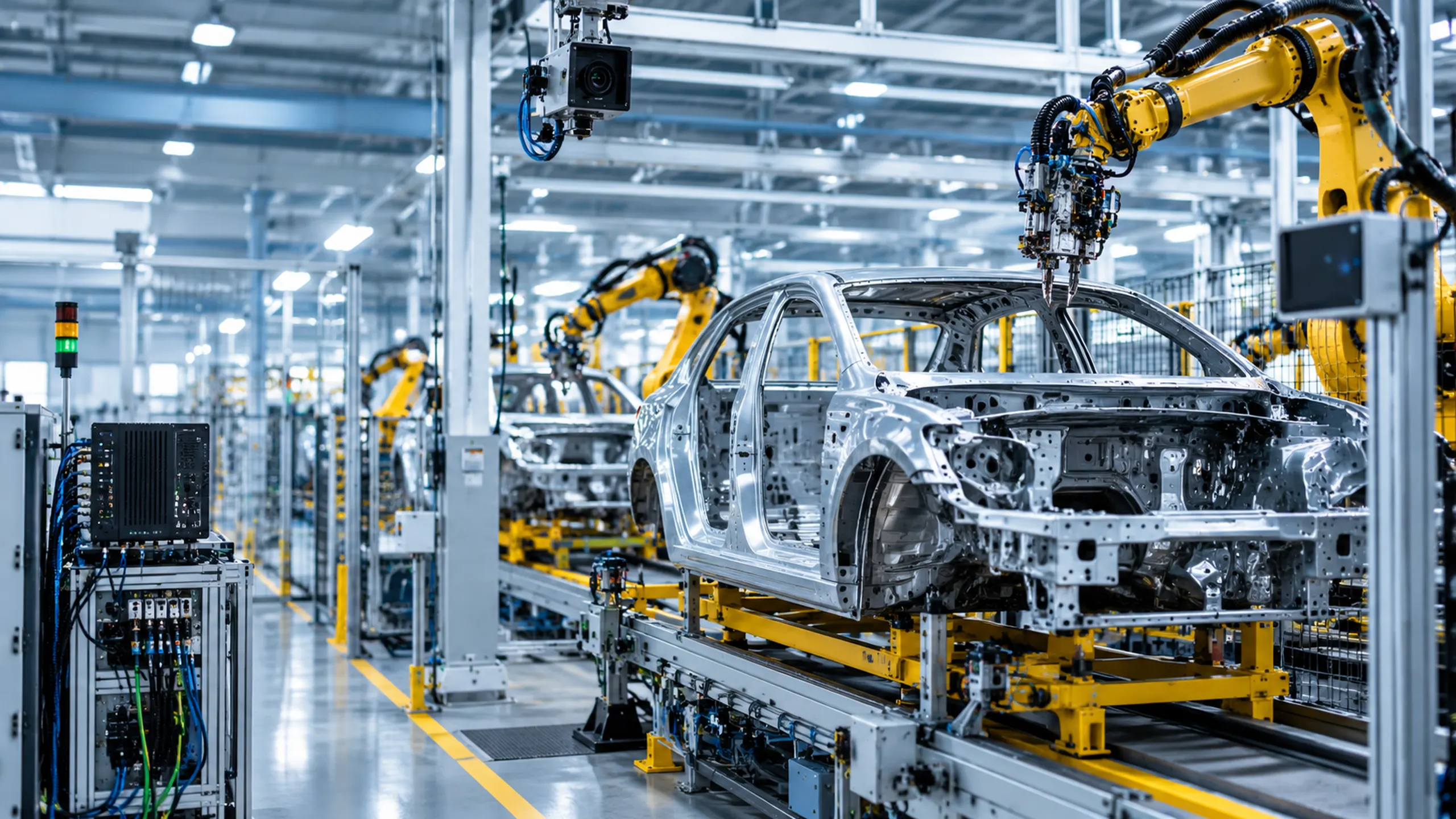
How the Technology Fits Together

A typical workflow starts by associating an observation with the correct vehicle component, tool, fixture, or machine. Sensors and connected devices then provide measurements or events with timestamps and quality information. Software checks and contextualizes the data before analytics or rules produce an alert, recommendation, or decision proposal. If a physical response is in scope, the approved command passes through the designated control interface and is checked against operating constraints. Subsequent observations should be used to confirm what actually happened rather than treating command acknowledgment as proof of completion.

For example, a production team could evaluate whether sensor readings and maintenance records provide enough context to prioritize inspection of a station on a body-in-white or final-assembly line. The evaluation would define the equipment boundary, baseline workflow, available history, alert criteria, responsible reviewer, and measures such as false-alert rate, detection delay, missing-data behavior, and maintenance effort. This is an illustrative workflow, not a claim of an existing customer deployment or a validated OEMNex implementation.

Factors to Evaluate Before Selecting a Solution

  • Operating environment: temperature, vibration, dust, fluids, electromagnetic conditions, line speed, and physical access.
  • Data requirements: asset identifiers, event timestamps, units, sampling rates, history, labels, and quality indicators.
  • Response needs: acceptable latency, local operation during connectivity loss, buffering, and recovery behavior.
  • Interoperability: available device interfaces, data formats, plant-system ownership, and the effort required to validate each connection.
  • Maintainability: calibration, device replacement, software updates, version control, support ownership, and staff training.
  • Safety and security: least-privilege access, auditability, command authorization, independent safeguards, and manual override.
  • Evidence: defined baseline, representative test conditions, acceptance criteria, documented limitations, and independent review where practical.

Define the Implementation Boundary

Before deployment, distinguish components that have been tested from proposed designs and third-party dependencies. A stated intention to support multiple suppliers does not establish compatibility with every device or protocol. Confirm equipment models, interface documentation, network and security requirements, data rights, system ownership, commissioning responsibilities, and the procedure for handling faults or rejected commands. A software demonstration alone does not establish production readiness or safe physical control.

Explore the Technology Areas

AI Software and Analytics

Review data preparation, inference, evaluation, model versioning, and monitoring.

Explore

IoT Software

Explore device connectivity, event processing, data quality, and operational records.

Explore

Identification and Sensing Hardware

Compare identification devices, sensors, gateways, and edge hardware for the plant environment.

Explore

Physical Action and Control Technologies

Understand controllers, actuators, equipment interfaces, authorization, and outcome checks.

Explore

System Integration and Deployment

Review enterprise integration, deployment choices, reliability, and validation requirements.

Explore

Physical AI and AIoT Engines Architecture

See how identification, sensing, decisions, action, and feedback relate.

Explore

Knowledge Center

Find guidance for technology selection and pilot evaluation.

Explore

Discuss Your Requirements

Start with the production workflow, equipment or asset class, data already available, required decision, and constraints that cannot be violated. OEMNex can use those requirements as the basis for a technical discussion about integration dependencies, evaluation measures, and the evidence needed before a pilot or deployment decision.

Scroll to Top