
Identification Engine
For asset and event association.
ExploreThe OEMNex Sensing Engine is a functional part of a Physical AI and Artificial Intelligence of Things (AIoT) architecture. It focuses on capturing physical measurements that help teams understand vehicle manufacturing equipment, components, and production conditions. Measurements are most useful when they are tied to the correct asset, timestamp, unit, and operating state, then checked for reliability before they inform a decision.
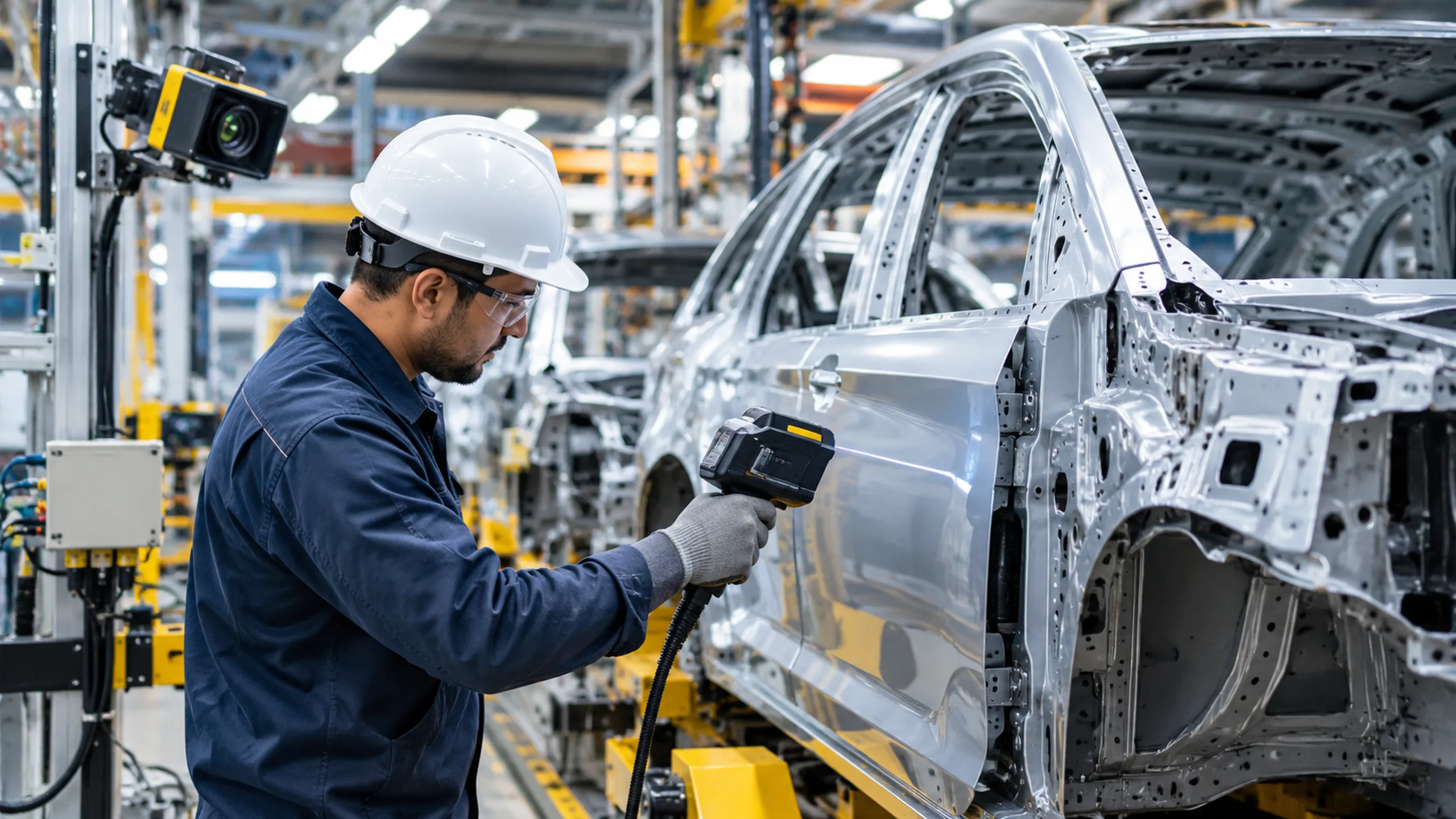
In an original equipment manufacturer (OEM) vehicle plant, sensing requirements vary by process and equipment. Depending on the use case, relevant inputs may include:
These are examples of possible sensing inputs, not a statement that every sensor type, device, or integration is currently supported by OEMNex. The right selection depends on the measurement objective, the equipment interface, the production environment, and the evidence available for evaluation.
A reading on its own rarely explains what is happening on a production line. A sensing workflow should associate each observation with an asset or station identifier, a timestamp, a unit of measure, the relevant operating mode, and a quality indicator. Where images or derived features are used, their source and processing steps should also be recorded.
For example, a body-in-white inspection station may capture dimensional measurements or images of a vehicle body. The records can be associated with the station and vehicle build context, then reviewed for gaps, inconsistent timestamps, or out-of-range values. The Sensing Engine supplies the observation layer; determining whether a measurement indicates a defect or requires intervention belongs to downstream analysis and quality workflows.
Reliable sensing starts with an explicit acquisition plan. Engineers should document the measurement range, sampling interval, sensor location, calibration method and status, units, time synchronization, and connectivity path. Sampling must be appropriate to the behavior being observed; a slow trend and a rapidly changing machine signal may require different acquisition settings.
The data pipeline should also account for common failure conditions:
Quality rules should preserve the original observation where practical, record any filtering or transformation, and make uncertainty visible to downstream users. Thresholds and acceptable ranges must be selected for the specific equipment and process rather than assumed to apply across an entire plant.
Validated measurements can support trend review, condition monitoring, inspection review, and the investigation of process anomalies. When paired with equipment history and production context, they may help maintenance, manufacturing engineering, controls, and quality teams decide what to investigate next. The Sensing Engine does not by itself establish a root cause, confirm a defect, or authorize a machine action. Those outcomes require appropriate analysis, review, and, where relevant, independent verification.
A useful evaluation should measure the quality of the observations as well as the usefulness of the downstream workflow. Candidate measures include data completeness, invalid-reading rate, time-alignment error, calibration effort, detection delay, false-alert rate, and the amount of manual review required. The baseline, time window, units, and calculation method should be agreed before a pilot.
Before selecting sensors or connecting data to plant systems, define the equipment boundary, the decision the data is intended to support, and who is responsible for acting on the result. Confirm mounting and environmental constraints, power and network availability, required sampling behavior, data retention, access controls, and the interface to existing manufacturing or maintenance systems.
Protocol and device compatibility should be verified for the specific configuration. A proposed architecture or illustrative example is not proof of a tested connector, calibrated field performance, or a production deployment. Where data is synthetic or simulated, it must be labeled accordingly and must not be described as calibrated field measurement.
The Sensing Engine works alongside the wider engine architecture and implementation choices.
Discuss your vehicle-manufacturing application with OEMNex. Identify the equipment or process, the physical variables that matter, the available sensor and production data, and the decision the measurements should support. This information can help define a practical evaluation plan and clarify the integration and validation work required.