
Identification and Sensing Hardware for OEM Vehicle Manufacturing
Hardware selection begins with the physical setting and the information required. In an original equipment manufacturer (OEM) vehicle plant, identification devices help associate vehicle bodies, components, tools, and work-in-process with production records. Sensors capture conditions such as temperature, vibration, pressure, position, presence, and image characteristics. Gateways and edge computers move or prepare these observations for the systems that use them. Each component must be selected as part of an operational system, with attention to line speed, metal structures, electrical noise, washdown or dust exposure, mounting space, power, connectivity, and service access.
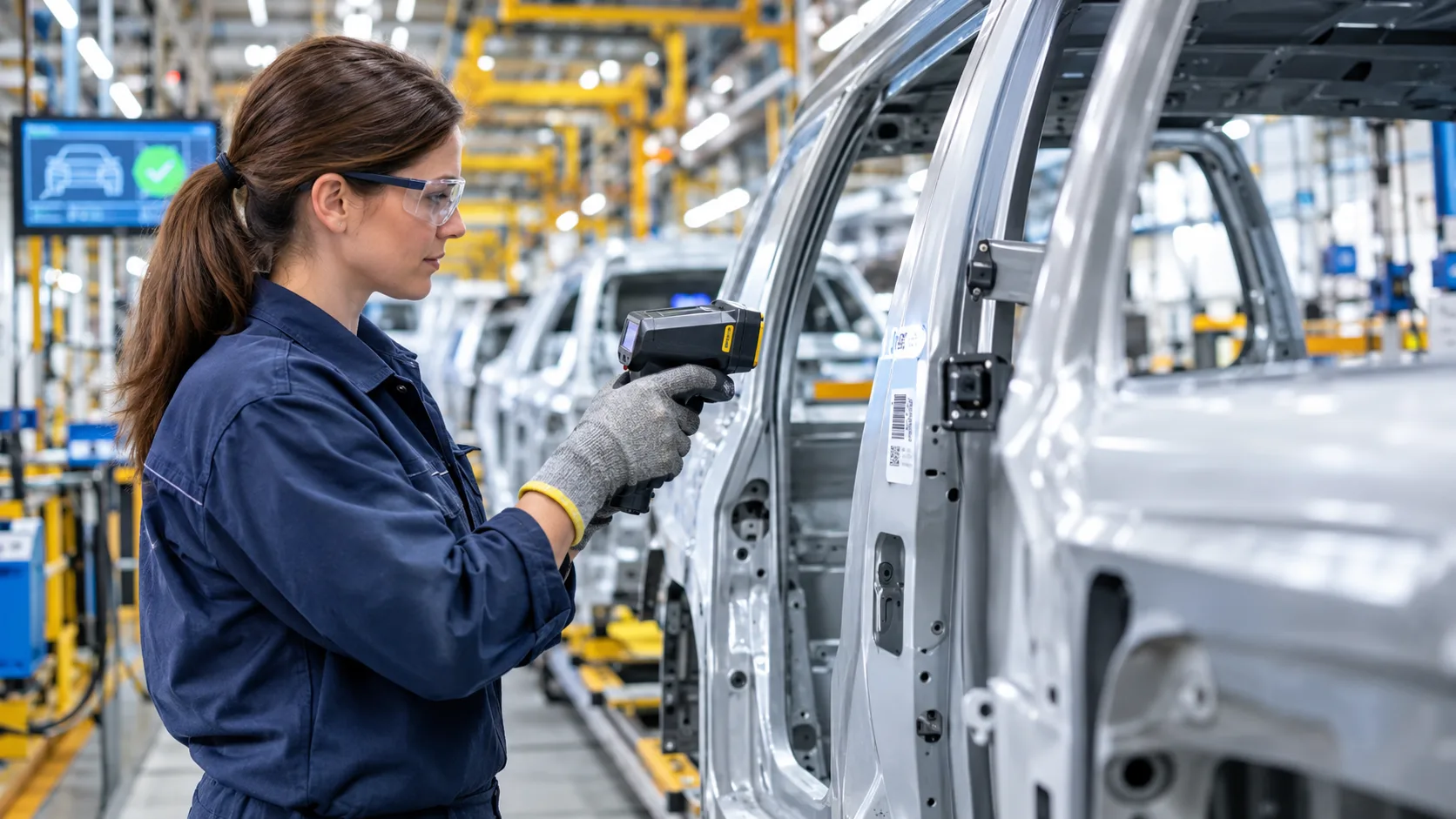
The right design depends on the decision the information must support. A station confirming that the correct component reached a vehicle may need a reader and a durable identifier. A station monitoring a press, conveyor, or fastening tool may need a suitable sensor and a reliable way to associate readings with equipment state and production context. OEMNex helps teams assess these functional requirements and define the hardware, data, and integration questions that need validation before deployment.
Identification Hardware for Vehicle and Component Traceability
Identification hardware connects a physical object or production event to a record. In vehicle manufacturing, possible targets include body-in-white assemblies, powertrain and chassis components, battery packs, electronic modules, reusable containers, fixtures, and production tools. The identifier and reader arrangement should match the object’s lifecycle, the required read distance, the speed of movement, and the point at which the event must be captured.
Radio-frequency identification (RFID) can support non-line-of-sight reads when the tag, reader, mounting position, and surrounding materials are suitable. Barcode and two-dimensional code readers provide a direct optical association but depend on label condition, visibility, lighting, and presentation. Bluetooth Low Energy (BLE) devices can support presence or proximity workflows when their location estimates and battery-maintenance needs fit the task. Cameras and machine vision can identify visible features or verify part presence, but image quality depends on lighting, angle, occlusion, surface finish, and the inspection method.
A read is not automatically proof that a part was installed correctly or that a transfer was completed. Production software should distinguish the observed identifier from the business event inferred from it. Where the process requires stronger evidence, combine identification with station state, work instructions, tool results, or an independent confirmation step.
Sensing Hardware for Production Equipment and Quality
Sensor selection starts with the physical variable and the operating range that matters. Temperature sensors may monitor equipment, fluids, or controlled process conditions. Vibration sensors can support condition monitoring on motors, pumps, fans, presses, and conveyors. Pressure and flow instruments may be relevant to pneumatic, hydraulic, cooling, or dispensing systems. Proximity, photoelectric, and position sensors can confirm presence, movement, or fixture state. Cameras and specialized optical sensors can support checks such as component presence, connector seating, surface appearance, or label readability.
The measurement range, accuracy, response time, sampling interval, mounting method, and calibration requirements should be defined for the actual task. A sensor mounted on a vibrating machine frame may need a different mounting and cabling approach from one installed near a precision inspection station. Heat, oil, metal dust, coolant, cleaning chemicals, electromagnetic interference, and access restrictions can affect reliability. Raw readings should retain units, timestamps, source identity, and quality indicators so that downstream software can distinguish a real change from a sensor fault or missing data.
AI-supported analysis may use these observations to identify unusual patterns or route a condition for review. The usefulness of an alert depends on representative operating data, a defensible baseline, and a defined response. Sensor output alone does not establish a root cause, a defect, or a maintenance requirement.
Gateways, Edge Computers, and Connectivity
Gateways connect field devices to local networks or higher-level systems and may translate protocols, buffer observations, or apply basic filtering. Edge computers can perform local data checks, image processing, event association, or selected AI inference where response time, bandwidth, or network availability makes local processing useful. The design should specify power, enclosure rating, network interfaces, storage, time synchronization, remote administration, update ownership, and recovery behavior after an interruption.
Plant connectivity must be assessed against existing network policies and the needs of production systems. A proposed device interface is not the same as a tested integration. Before choosing hardware, confirm how identifiers, measurements, event timestamps, and device-health states will be delivered to the relevant manufacturing execution system (MES), enterprise resource planning (ERP) system, computerized maintenance management system (CMMS), or other approved application. Do not assume that every device, protocol, or enterprise connector is supported without validation.
Hardware Selection Matrix
| Hardware function | Typical OEM use | Key selection factors | Installation and service | Validation focus |
|---|---|---|---|---|
| RFID tag and reader | Identify components, containers, fixtures, or assemblies at a defined station | Tag material and orientation, read zone, metal interference, cycle time | Mounting, antenna placement, tag attachment, reader access | Read coverage, missed and duplicate reads, correct asset association |
| Barcode / 2D code reader | Capture a visible part or vehicle identifier | Code quality, line speed, lighting, distance, line of sight | Label placement, cleaning, optics access | Decode rate under real lighting and surface conditions |
| BLE or other location device | Presence or zone-level visibility for selected assets | Required location granularity, battery life, RF environment | Anchor placement, battery replacement, network coverage | Zone accuracy, stale observations, maintenance workload |
| Condition sensor | Measure vibration, temperature, pressure, position, or other variables | Range, accuracy, response, sampling, environment | Mounting, wiring, calibration, safe access | Measurement quality, drift, missing readings, baseline suitability |
| Camera / vision sensor | Check part presence, visible features, or surface condition | Field of view, resolution, lighting, occlusion, cycle time | Rigid mounting, lighting control, lens cleaning | False accepts, false rejects, and performance by defect class |
| Gateway / edge computer | Collect, buffer, normalize, or locally process device data | Interfaces, compute, storage, latency, security, availability | Power, enclosure, network access, patching | Recovery, timestamp consistency, data loss, interface behavior |
Conceptual Hardware Bill of Materials
The following is a functional example for a hypothetical vehicle assembly station that associates a component identity with a station event and records one equipment condition. It is not a product recommendation or a statement of verified compatibility. Quantities and specifications must be confirmed through a site survey and a pilot.
| Function | Illustrative quantity | Purpose | Open validation questions |
|---|---|---|---|
| Identification reader and suitable tag or code | 1 reader; identifiers as required | Capture component or assembly identity at the station | Read zone, mounting, identifier durability, cycle time |
| Selected condition or presence sensor | 1 sensor for the chosen variable | Capture the measurement or station state needed by the workflow | Range, sampling interval, calibration, environmental rating |
| Industrial gateway or edge device | 1, if required by the interface design | Collect data and deliver normalized events to an approved system | Protocols, buffering, network approval, security, recovery |
| Mounting, power, cabling, and protective enclosure | As determined by survey | Provide reliable installation in the actual production environment | Cable routing, noise, service access, environmental exposure |
| Integration and validation effort | Defined during project planning | Map device observations to production records and test exceptions | MES/ERP interface, timestamps, duplicate handling, acceptance criteria |
Example Workflow: Component Identification at an Assembly Station
A hypothetical assembly station receives a vehicle body and a component scheduled for installation. A reader captures the component identifier, while the station system supplies the vehicle or work-order context. Software checks whether the identifier is expected for that station and records the event with its timestamp and source. If the read is missing, duplicated, stale, or inconsistent with the work order, the system routes the event for operator review rather than silently treating it as a completed installation. Where required, a separate tool result or inspection confirms the operation.
A pilot should measure event completeness, incorrect associations, duplicate-event handling, unresolved exceptions, and added operator effort. For sensor workflows, include measurement quality, missing-data behavior, calibration checks, and alert usefulness. Test across relevant shifts, product variants, line speeds, and equipment states before extending the design.
Installation, Data Quality, and Maintenance Considerations
Hardware performance depends on installation details as much as nominal device capability. Confirm the mounting position, cable route, protection from impact, cleaning access, power availability, and exposure to heat, vibration, fluids, dust, and electromagnetic noise. For radio-based identification, test the actual reader and tag arrangement around metal structures and moving equipment. For cameras, test realistic lighting, reflections, part variation, and occlusion. For sensors, document calibration method, measurement range, sampling interval, units, and expected behavior when readings are invalid.
Define how the system handles missing, late, repeated, or conflicting observations. Keep device health and data quality separate from the measured process state. Maintenance teams should know how to inspect mounts, replace batteries where applicable, clean optics, verify calibration, update firmware, and restore settings after replacement. Time synchronization and stable asset identifiers are important when observations from multiple devices are combined.
Pilot Planning and Acceptance Criteria
A practical pilot should begin with a specific production question, such as whether the correct component identity can be captured at a station without slowing the line, or whether a selected sensor can provide reliable condition data during normal and abnormal operating modes. Record the baseline workflow, the relevant product variants, operating conditions, data owners, integration boundary, and responsible users before testing.
- Confirm the required identification or measurement and the decision it must support.
- Document device placement, power, connectivity, environment, calibration, and service access.
- Define event completeness, false associations, missed observations, data availability, or measurement-quality criteria as applicable.
- Test exceptions including duplicate reads, stale timestamps, sensor drift, network interruption, and device replacement.
- Verify that the resulting records reach the intended application and retain sufficient context for audit and troubleshooting.
- Record which components and interfaces were tested, which remain proposed, and what requires site-specific approval.
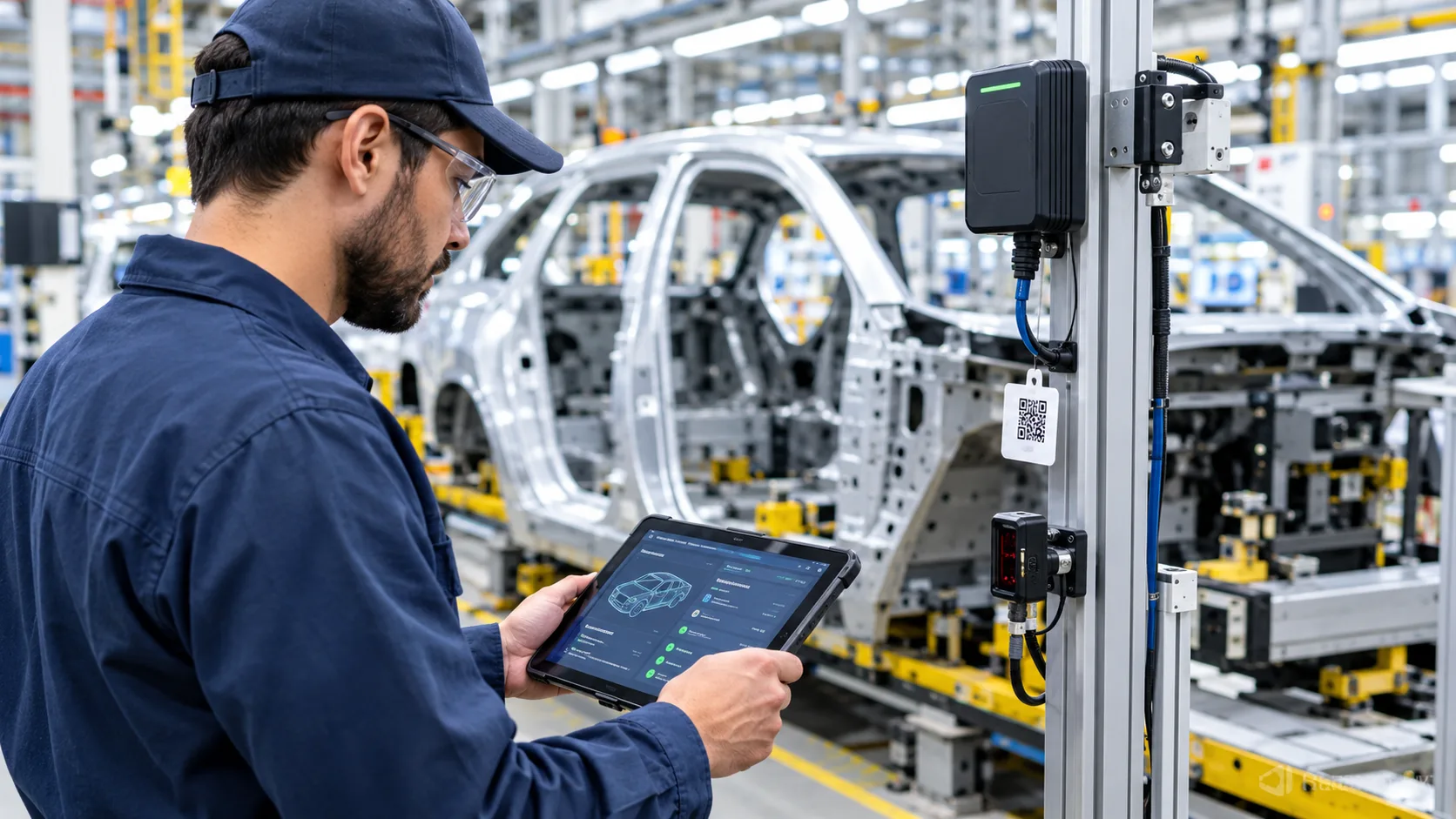
Discuss Your Hardware Requirements
Share the production workflow, target assets or measurements, operating environment, and existing system interfaces you need to support. OEMNex can help frame the identification and sensing requirements, installation constraints, and validation questions for an automotive manufacturing use case. Device selection and compatibility should be confirmed against the specific plant and proposed implementation.