
Integrating Physical AI and AIoT with Industry Systems
Reliable system integration turns observations from automotive production equipment into operational records that manufacturing, maintenance, quality, and enterprise teams can use. For Physical AI and AIoT deployments, the integration design should define where information originates, how equipment and vehicle identifiers are associated, when events are considered valid, and what happens when an exchange is delayed or rejected.
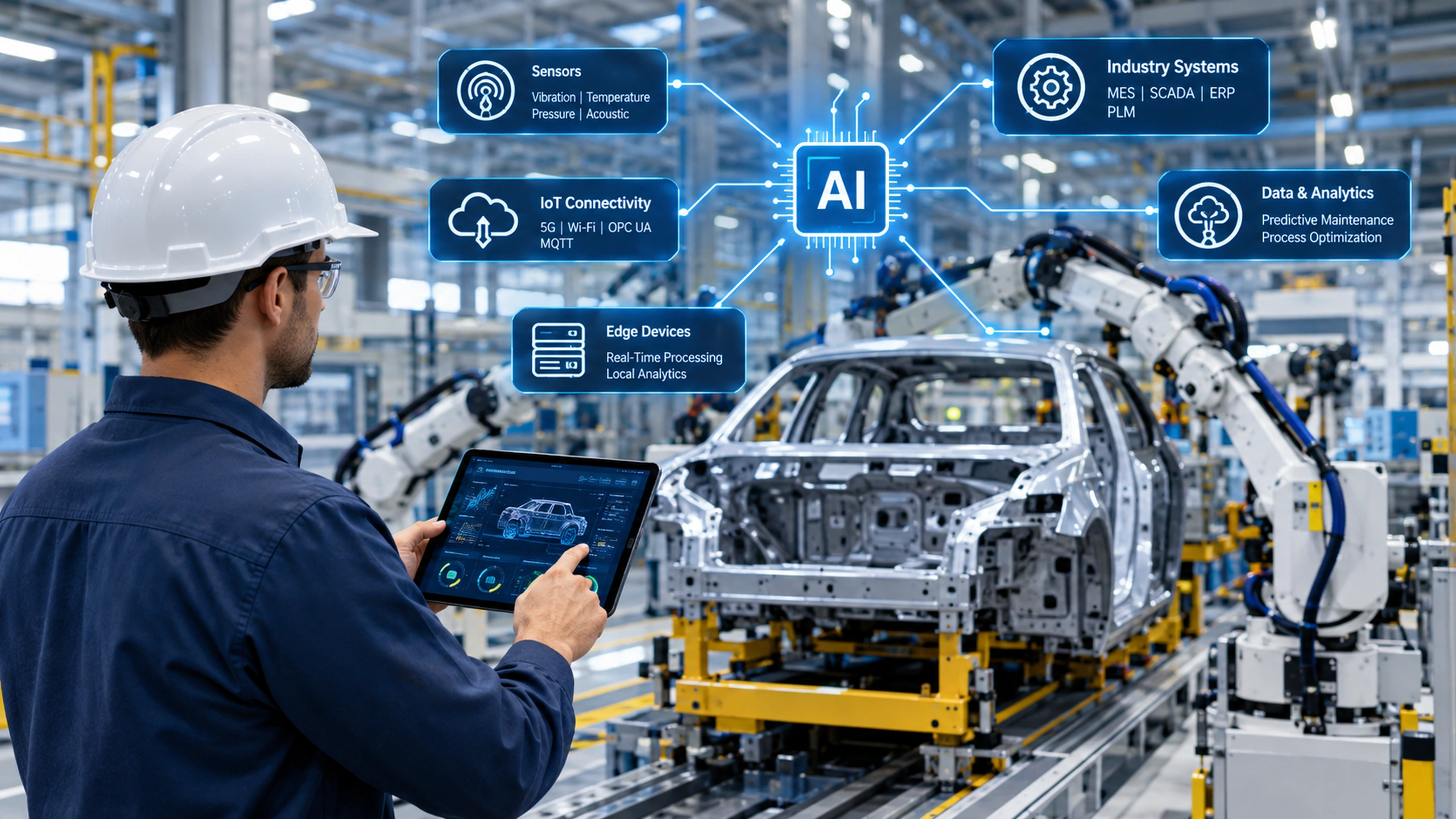
In an automotive manufacturing environment, that means connecting physical assets such as body shop robots, conveyors, torque tools, weld cells, inspection stations, programmable logic controllers, sensors, and edge devices with systems such as manufacturing execution systems (MES), enterprise resource planning (ERP), warehouse management systems (WMS), computerized maintenance management systems (CMMS), and supervisory control and data acquisition (SCADA). The objective is not simply to move more data. It is to preserve enough context and control to make each record trustworthy and useful.
What should be defined before integrating Physical AI and AIoT?
Start with the operational event rather than the interface technology. Identify the equipment or process that produces the observation, the system that owns the resulting record, the identifier used to associate the event with a vehicle, component, machine, work order, or production operation, and the timing requirements. Then define validation rules, acknowledgment behavior, ownership, and recovery procedures.
For an automotive plant, a useful integration boundary might begin with a sensor or machine controller on an assembly line, pass through an edge gateway or IoT software layer, and end in an MES or maintenance application. AI-supported analysis may sit between these layers when the workflow requires anomaly detection, prediction, inspection assessment, or prioritization. The integration contract should make clear which component observes, which component interprets, and which system records the business event.
- Asset and equipment identity: Use stable identifiers for production lines, workstations, robots, tools, sensors, vehicle units, and relevant components.
- Event definition: Specify what happened, such as a cycle completion, torque result, inspection result, machine-state change, maintenance condition, or material handoff.
- Timing: Define event time, ingestion time, time zone, clock synchronization expectations, and acceptable delay.
- Context: Include production order, vehicle or component association, operating mode, station, recipe or configuration where relevant, and data-quality status.
- Ownership: Identify which system is authoritative for each field and which system is responsible for correction or reconciliation.
Worked automotive manufacturing event: recording a production-station result
Consider a body shop station where a vehicle body reaches a defined operation, equipment records the cycle, and a measurement or inspection result must be associated with that vehicle. The physical equipment can generate the observation, while the MES remains the operational record for production status. An AIoT integration layer can validate and enrich the event before forwarding it to the MES or another approved application.
The event should carry enough information to connect the physical observation with the manufacturing record without exposing confidential production data. A conceptual event mapping can include a vehicle or unit identifier, station identifier, event type, event timestamp, measurement value, measurement unit, equipment identifier, source status, and integration status. The exact field names should follow the receiving system’s data contract rather than being imposed by the AIoT layer.
- Source: station controller, sensor gateway, inspection device, or edge application.
- Identifier: vehicle unit ID, component ID, workstation ID, equipment ID, or another approved production identifier.
- Event: cycle complete, inspection complete, measurement captured, equipment state change, or maintenance condition detected.
- Time: source timestamp plus ingestion or processing timestamp where needed for traceability.
- Measurement: value, unit, quality flag, and applicable operating context.
- Destination: MES, CMMS, ERP, WMS, SCADA, data platform, or another approved system.
The receiving system should acknowledge accepted records and return a defined response for rejected records. If the event cannot be accepted because an identifier is unknown, a required field is missing, the timestamp is invalid, or the receiving service is unavailable, the integration layer should preserve the original event and its failure reason for controlled recovery.
Mapping physical observations to enterprise records
Good integration separates physical-world observations from business records while maintaining the associations between them. A vibration reading from a robot drive, for example, is a measurement. A maintenance work order created after reviewing that measurement is a business record. Treating those as the same object can make ownership, retention, correction, and audit behavior difficult to manage.
The mapping should also account for equipment state and operating context. A temperature value from a welding controller has a different meaning during startup, steady production, changeover, and maintenance. The same principle applies to vision inspection results, torque measurements, motor current, pressure, flow, and other signals used by Physical AI or AIoT applications.
Use data contracts to make integrations testable
A data contract should define the fields, formats, required values, units, identifier rules, timing expectations, and acceptable status codes for an exchange. It should also define how unknown identifiers, duplicate records, out-of-range values, missing measurements, and unsupported event types are handled. This gives software developers, system integrators, controls engineers, and manufacturing IT teams a common specification for testing.
Where AI is involved, the contract should distinguish measured data from inferred results. For example, a sensor can provide a measured vibration value, while an AI model can produce an anomaly score or maintenance priority. The downstream application should know which value is directly observed, which is derived, and what validation or review is expected before it is used operationally.
Choosing the exchange method
The appropriate exchange method depends on the systems already operating in the plant, required timing, data volume, network boundaries, and ownership. Common approaches include APIs, message-based interfaces, industrial protocols, database integration, file-based exchange, and middleware or IoT platforms. The choice should be made against the operational workflow, not because one interface pattern is universally preferable.
- APIs are useful when an enterprise application exposes a controlled service for creating, retrieving, or updating records.
- Message-based exchange can support event-driven workflows where production events must be delivered without tightly coupling every system.
- Industrial protocols can connect equipment and controls to an edge or integration layer, while enterprise-facing interfaces handle business records separately.
- Middleware can normalize identifiers, validate events, buffer messages, manage routing, and maintain integration logs between plant systems.
Integration teams should document the boundary between equipment communication and enterprise integration. A PLC or robot controller may provide a machine state, but it does not automatically define the business meaning of that state. The integration layer and receiving application must establish how a machine event becomes a production, quality, inventory, or maintenance record.
Handling duplicates, retries, delays, and rejected records
Failure handling is part of the integration design, not an exception to it. Automotive plants operate continuously, and network interruptions, service restarts, device reboots, clock differences, temporary database failures, and maintenance windows can interrupt data exchange. A reliable system should preserve enough information to determine what happened and whether the receiving system accepted it.
- Duplicate events: Use event identifiers or another idempotency mechanism so a retry does not create multiple business records.
- Retries: Define retry limits, intervals, and the point at which an event moves to a controlled exception queue or reconciliation process.
- Delayed events: Preserve source time and arrival time so users can distinguish when an event occurred from when the system received it.
- Rejected records: Store the rejection reason and retain the original payload or an appropriate traceable representation for correction.
- Reconciliation: Provide a method for comparing source records with destination records and resolving differences under defined ownership.
For example, if an assembly station completes a cycle while the MES connection is unavailable, the edge integration layer can buffer the event rather than discarding it. When connectivity returns, the event can be validated and submitted. If the MES rejects it because the vehicle identifier is not recognized, the integration process should stop treating the event as successfully delivered and route it for controlled investigation.
Security, permissions, and audit records
Physical AI and AIoT integrations can expose production data and, in some architectures, create paths toward equipment control. Access should therefore be limited to the systems, services, and users that require it. Define authentication, authorization, network boundaries, protected communications, logging, and update responsibilities as part of the integration design.
For operational workflows, distinguish information exchange from physical control. An AI-supported recommendation sent to a maintenance application is different from a command that changes equipment behavior. Where a system can influence physical equipment, the integration must respect approved authority, operating limits, equipment protections, manual controls, and verification requirements.
Integration testing and business acceptance
A connector should not be considered ready because messages can travel from one endpoint to another. Testing should demonstrate that the right event reaches the right system, retains its identity and timing, is interpreted correctly, and remains traceable when something goes wrong.
- Verify permissions for each service account, integration endpoint, and administrative function.
- Test valid, incomplete, malformed, duplicated, delayed, and out-of-order events.
- Confirm identifier mapping across equipment, vehicles, production orders, workstations, and maintenance records.
- Test acknowledgments, retries, buffering, rejection handling, and reconciliation after an outage.
- Verify audit records show what was received, processed, rejected, corrected, and delivered.
- Assign ownership for interface changes, data-quality issues, incident handling, and recovery procedures.
- Obtain business acceptance from the manufacturing, quality, maintenance, IT, and system-owner teams affected by the workflow.
A practical integration checklist for automotive manufacturing
Before moving a Physical AI or AIoT integration into broader use, document the complete path from physical observation to operational record. The following checklist keeps the review focused on measurable behavior and accountable ownership.
- Define the automotive manufacturing workflow and the business decision it supports.
- Identify every source, destination, gateway, edge device, and integration service in the data path.
- Document identifiers, event types, timestamps, units, context fields, and quality flags.
- Define validation, acknowledgment, synchronization, buffering, retry, and rejection behavior.
- Test normal operation and realistic failure conditions, including communication loss and service restart.
- Confirm security controls, permissions, logging, and access boundaries.
- Define reconciliation procedures and the owners responsible for resolving mismatches.
- Separate tested connectors and verified behavior from proposed interfaces or future capabilities.
- Record acceptance criteria and evidence before expanding the integration to additional lines, plants, or workflows.
Where Physical AI and AIoT fit in the integration architecture
Physical AI and AIoT can provide useful functions at different points in an automotive manufacturing architecture. Identification and sensing establish the physical context. Edge and IoT software collect, validate, and route observations. AI can analyze those observations for detection, prediction, prioritization, or optimization. Enterprise and manufacturing systems preserve the operational records and workflows that people already use.
The strongest architecture is therefore not the one with the most connected devices. It is the one that makes the physical observation, derived result, business record, responsible system, and recovery path clear. That clarity gives manufacturing engineers, controls teams, IT architects, software developers, maintenance leaders, and system integrators a practical basis for testing and operating the system.
Related OEMNex resources
- Technology and Integration: /technology-integration/
- IoT Software: /technology-integration/iot-software/
- System Integration and Deployment: /technology-integration/system-integration-deployment/
- Physical AI and AIoT Engines Architecture: /physical-ai-aiot-engines-architecture/
- Cybersecurity and Physical Action Safeguards: /knowledge-center/cybersecurity-action-safeguards/
Next step
For an automotive manufacturing integration assessment, start with one defined workflow, such as a production-station event, equipment condition record, inspection result, or maintenance trigger. Map the physical source, identifiers, data contract, receiving system, failure behavior, and acceptance criteria before selecting the final interface and deployment arrangement.
Contact OEMNex