
Cybersecurity, Physical Security, and Trusted Industrial AI Research for OEM Vehicle Manufacturing
Connected automotive manufacturing depends on trustworthy observations and authorized actions.
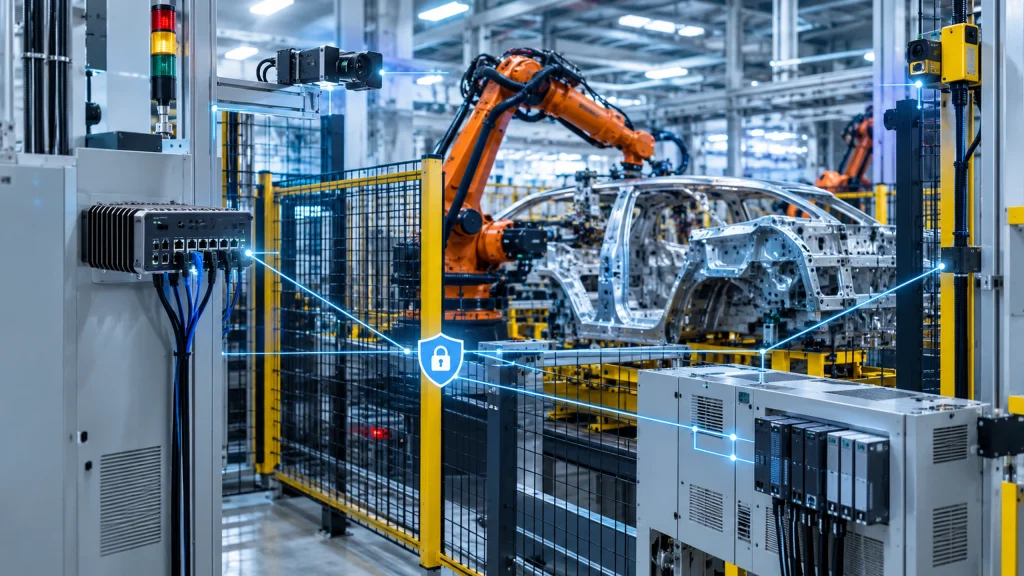
Industrial sensors, robotic work cells, programmable controllers, machine-vision systems, autonomous material-handling platforms, and manufacturing software exchange information that can influence production decisions and physical movement. Research in this area examines how to protect devices, data, AI decisions, command paths, and physical assets while maintaining essential manufacturing operations.
The focus is the production environment of original equipment manufacturers (OEMs), including body shops, paint shops, general assembly, powertrain and component assembly, end-of-line inspection, and intraplant material movement where those settings are relevant to a defined study. Security questions must be considered alongside line availability, product quality, worker privacy, equipment protection, and recovery requirements.
Research priorities for automotive manufacturing
The research agenda considers security across the path from physical observation to a decision, an authorized command, and a verified equipment outcome. Topics are selected according to the equipment, interfaces, and operating conditions under study rather than assuming that every factory uses the same architecture.
Device identity, onboarding, and network access
Research questions include how an industrial sensor, edge gateway, robot controller, vision system, or mobile platform can establish its identity, receive approved configuration, and be managed through its service life. Candidate methods include device inventory and identity checks, controlled onboarding, credential rotation, network segmentation, and least-privilege remote access. Evaluation should examine unauthorized access attempts, detection delay, false alarms, maintenance burden, and whether legitimate production tasks remain available.
Sensor integrity and trusted AI decisions
A compromised, misconfigured, or spoofed observation can distort machine-state estimates, defect assessments, robot localization, or production recommendations. Candidate studies can inject controlled sensor anomalies, stale values, incorrect asset associations, and manipulated perception inputs in an isolated test environment. Results should be compared with a documented baseline and should distinguish detection of suspicious data from proof of the underlying physical condition.
Command authorization and software supply-chain integrity
AI-supported recommendations must not become equipment commands without a defined authority path. Research can examine restricted command interfaces, role-based permissions, approval checks, signed or otherwise verified software and model artifacts, configuration provenance, and controlled update procedures. Test cases should include invalid authority, replayed or duplicated commands, compromised update packages, expired credentials, and commands based on stale state. The study should record whether the command was rejected, whether an alert was raised, and whether the physical outcome was independently checked.
Physical security, privacy, and mobile systems
Cybersecurity does not replace physical access controls or equipment safety. A complete research scope may include restricted access to control cabinets and network rooms, perimeter monitoring around production cells, protection of industrial assets, and correlation of access events with relevant system logs. Any use of cameras, location data, or workforce analytics should have a defined operational purpose, limited access, retention rules, and privacy review.
For autonomous mobile robots and other connected material-handling platforms, candidate work includes adversarial perception, localization interference, secure teleoperation, update integrity, and isolation of a compromised fleet member. Shared maps and fleet coordination data should be treated as security-relevant inputs. Testing should determine whether a platform can detect degraded or inconsistent information, move to an approved safe state, and rejoin operations only after required checks.
Incident containment, recovery, and verified restart
Security response in an automotive plant must account for production state, work in progress, equipment interlocks, quality controls, and the authority of plant personnel. A research demonstration can model a compromised gateway, unexpected device identity, abnormal command sequence, or loss of trusted sensor data. Candidate response steps include isolating the affected device or fleet member, preserving relevant logs, switching to an approved fallback workflow, checking equipment and product state, and requiring authorized review before restart.
A restart should not be considered verified merely because a system accepts credentials or a controller acknowledges a command. The evaluation should include independent checks of the relevant machine state, robot or vehicle position, cell status, and required quality or safety conditions. The exact checks depend on the selected production process and must be agreed with engineering and operational owners.
Proposed demonstration and evaluation approach
A suitable initial demonstration is an isolated, authorized testbed representing a bounded automotive manufacturing workflow. It may use simulated devices, a command gateway, a robot or mobile-platform simulator, and representative event records. Scenarios should cover normal operation and controlled failures, including manipulated observations, invalid authority, compromised updates, communications loss, and recovery. No testing should be performed against live production equipment or networks without explicit authorization and an approved safety plan.
Candidate evaluation measures include:
Residual unauthorized-action success: the share of unauthorized attempts that still result in an action.
Detection delay: elapsed time between a defined security event and its detection.
False-alarm rate: false alerts normalized to an explicitly stated operating period or event count.
Legitimate-task degradation: effect on approved production or maintenance tasks during security controls or incident handling.
Containment and recovery time: time required to isolate the affected component and restore approved operation.
Physical outcome verification: proportion of attempted eligible actions whose resulting state is independently confirmed.
Cryptographic migration cost: measured effects on latency, processing load, memory, bandwidth, and device compatibility when cryptographic options change.
Report the baseline, test conditions, number and type of scenarios, system configuration, metric definitions, and known limitations. Do not present simulated outcomes as field performance. A testbed can provide evidence about the tested controls under stated conditions, but it does not establish certification, complete security, or safe deployment.
Related research and technical resources
Explore the Physical AI and AIoT Research hub for the broader research program directory.
- Cybersecurity and Physical Action Safeguards
- Identification Engine
- Physical AI Action Engine
- IoT Software
- System Integration and Deployment
- Distributed Intelligence, Robotics, and Physical Logistics Research
- Verification, Human Oversight, and Emerging Connectivity Research
- Industrial Knowledge, Learning, and Deployment Research
Call to action
Discuss an automotive manufacturing security research question with OEMNex. Define the production workflow, equipment boundary, authorized test conditions, and evidence needed to evaluate the approach.