
Cybersecurity and Physical Action Safeguards for OEM Vehicle Manufacturing
Connected systems need controls for both information access and operational execution. In original equipment manufacturer (OEM) vehicle manufacturing, a compromised account, manipulated sensor reading, or invalid command can affect robotic cells, programmable logic controllers (PLCs), conveyors, fastening systems, inspection equipment, and production flow. Security design must protect data and software while also defining who may initiate an action, under what conditions it is allowed, and how the resulting equipment state is confirmed.
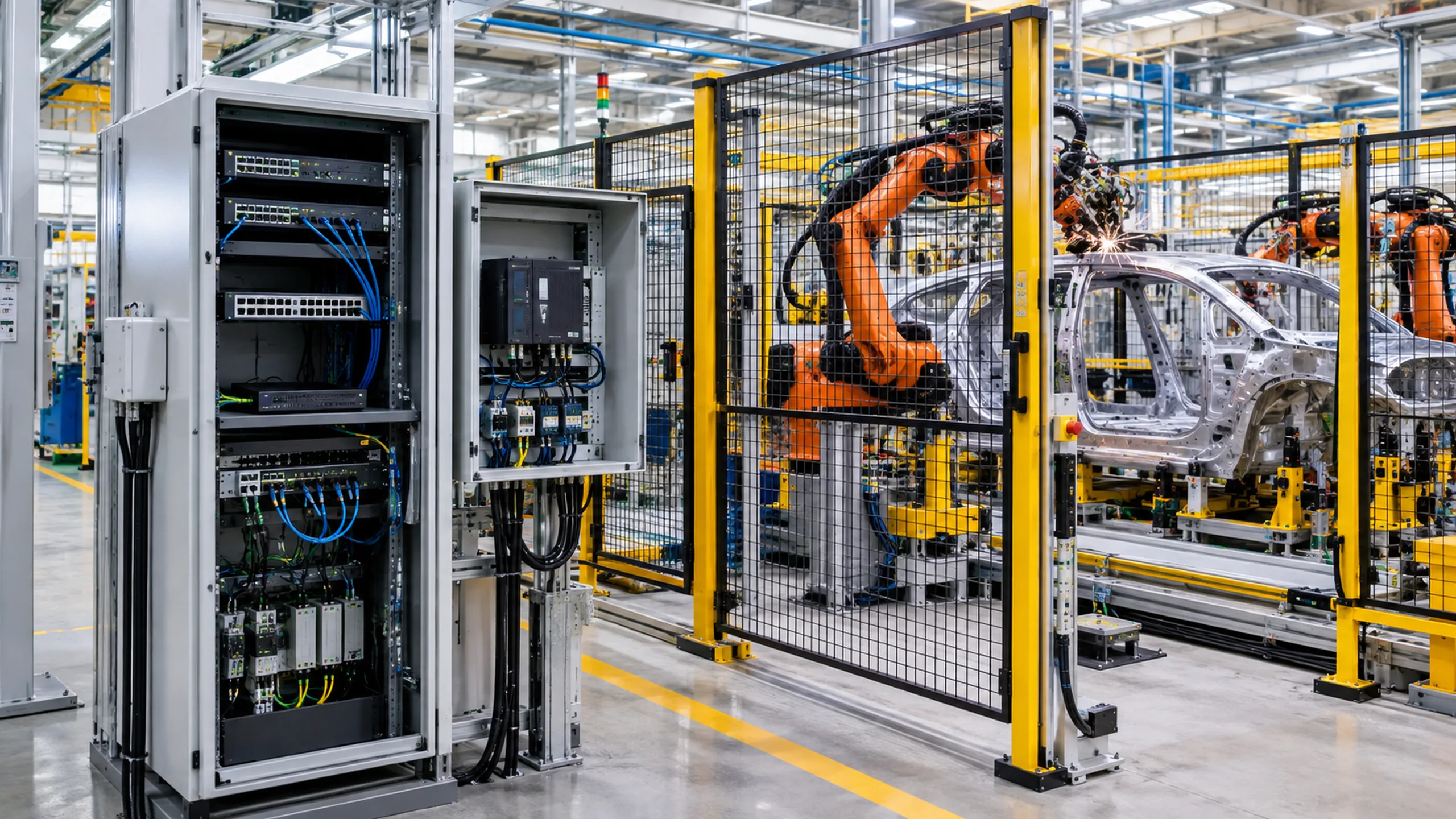
Cybersecurity and physical-action safeguards work together, but they are not interchangeable. Network controls and identity checks can reduce the chance of unauthorized commands. They do not replace machine guarding, safety-rated controls, validated interlocks, emergency stops, or the engineering review required before changing equipment behavior. Treat every connection between software and machinery as a defined trust boundary.
Map the System Boundary Before Choosing Controls
Start with an inventory of the devices, applications, networks, and people involved in the workflow. A representative vehicle manufacturing cell may include presence or condition sensors, RFID or Bluetooth Low Energy (BLE) identification devices where applicable, industrial gateways, edge computers, a manufacturing execution system (MES), supervisory control and data acquisition (SCADA) or human-machine interface (HMI) systems, PLCs, robot controllers, and maintenance workstations. The actual architecture varies by plant and equipment supplier, so document the installed configuration rather than assuming every component is present.
Map the route taken by each type of information and command. Identify which systems can read production data, change a setpoint, request a robot cycle, alter a recipe, acknowledge a fault, or administer a device. Separate monitoring-only connections from paths that can affect physical behavior. Record vendor remote-access paths, engineering laptops, wireless networks, cloud services, and temporary commissioning connections. Remove unused connections and close undocumented access paths.
Apply Layered Cybersecurity Controls
Use Individual Identities and Least Privilege
Give operators, controls engineers, maintenance technicians, integrators, and service vendors separate accounts with permissions matched to their duties. Avoid shared administrator credentials. Use multifactor authentication for remote and administrative access where technically feasible, and time-limit vendor access to an approved maintenance window. A person who needs to view a robot fault should not automatically receive permission to edit its motion program or change safety-related settings.
For devices and software services, maintain an approved inventory of identities, certificates or keys where supported, firmware and software versions, ownership, and lifecycle status. Disable default credentials and retire credentials when staff or vendors no longer need access. For legacy controllers that cannot support modern identity controls, document compensating measures such as tightly restricted network paths, monitored jump hosts, and controlled physical access.
Segment Networks and Protect Communications
Separate enterprise information technology (IT), manufacturing operations, cell-level control, safety-related systems, and remote-access services according to the risk assessment and plant architecture. Permit only required traffic between zones. Use firewalls, industrial demilitarized zones, access control lists, and monitored conduits where appropriate. Avoid placing a robot controller or PLC directly on an unrestricted business network or the public internet.
Protect communications against interception or alteration using supported encryption and authenticated protocols. Where older industrial protocols cannot provide these protections, reduce exposure through segmentation, controlled gateways, and strict access rules. Confirm protocol compatibility and timing requirements before introducing encryption, inspection, or gateway devices into a production path. Security changes must not unintentionally disrupt deterministic control or equipment availability.
Manage Updates, Configuration, and Logs
Maintain a patch and vulnerability process that accounts for supplier guidance, production schedules, safety requirements, and rollback plans. Test firmware, operating-system, application, and controller changes in a representative environment before production deployment. Back up approved robot programs, PLC logic, recipes, gateway configurations, and network rules; protect backups from unauthorized changes and test restoration periodically.
Collect logs for authentication, privilege changes, configuration edits, remote sessions, rejected commands, software updates, and relevant control events. Synchronize clocks where feasible so events can be correlated across the MES, gateway, edge service, and controller. Define who reviews alerts, how long records are retained, and how an incident is escalated. Logging is useful only when someone is responsible for acting on it.
Design Safeguards for Every Physical Action
A secure action path should make the transition from observation to physical execution explicit. In a conceptual workflow, a sensor or identification device supplies an observation; an application checks its source, timestamp, quality, and association with the correct asset; decision logic proposes an action; an authorization service evaluates the user, role, target, operating mode, and limits; and a validated control interface passes an allowed request to the equipment. The system then checks the observed equipment state rather than treating a message acknowledgment as proof that the action completed.
For example, software may request that a conveyor divert a body carrier to a designated inspection position after a quality exception. The request should include a unique command identifier, target equipment, intended operation, relevant state version, expiry or timeout, and authorization context. The controller or approved supervisory interface must reject commands that fall outside its configured operating limits. Duplicate requests should not trigger repeated physical movement. If the software cannot establish that the carrier and cell are in the expected state, it should withhold the command or request human review.
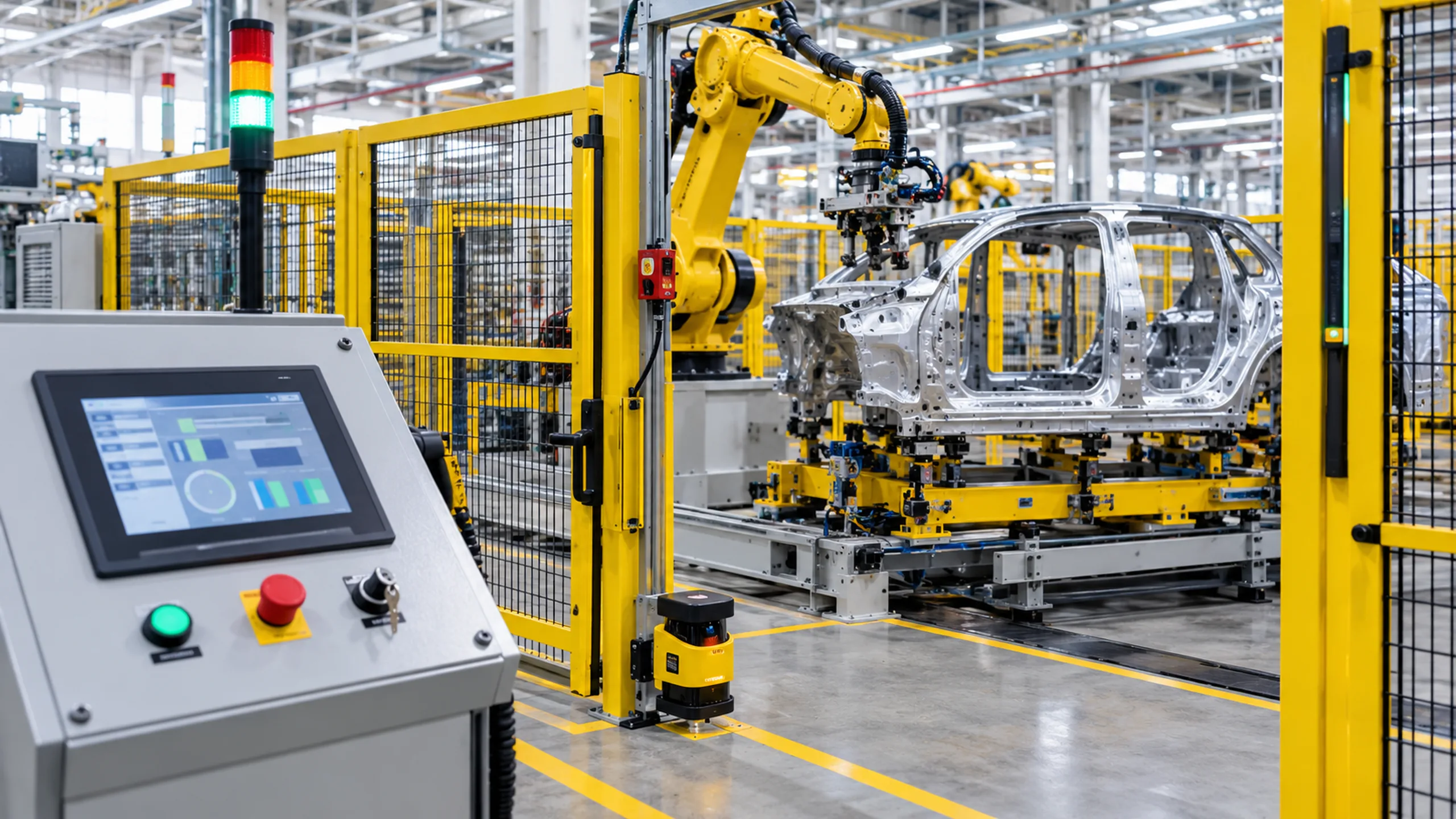
Keep protective functions independent of general-purpose AI or application logic wherever the risk assessment and applicable design requirements call for it. Machine guarding, safety interlocks, emergency stops, safe torque off, and safety-rated control functions must be selected, engineered, validated, and maintained for the actual machine and task. A cybersecurity permission check is not a safety function, and an AI model output is not proof that a movement is safe.
Define Authority, Limits, and Override Behavior
Specify which actions are recommendations, which require operator approval, and which may execute automatically within a bounded and validated operating envelope. Limit the target equipment, allowed command types, rate, duration, and operating conditions. Require renewed authorization when the operating mode changes, the observation becomes stale, the target changes, or a command exceeds its approved scope. Provide a clear way for authorized personnel to stop or override the process, subject to the machine’s safety design.
Distinguish supervisory commands from low-level control loops. An AI or orchestration service may request a permitted task, but the PLC or robot controller remains responsible for the validated control sequence assigned to it. Do not let an application bypass established interlocks or write directly to low-level control variables without an approved engineering design and risk assessment.
Plan for Stale Data, Invalid Commands, and Communication Loss
Security and reliability tests should include more than successful operation. Test what happens when a sensor report is delayed, an identifier is incorrectly associated with a vehicle body or fixture, a command is malformed, a credential is revoked, a gateway becomes unavailable, or a response is lost after a command is sent. Include compromised or replayed inputs in an authorized test environment. A system should not convert uncertainty into an unreviewed physical action.
Define the safe response for each failure mode with the equipment and safety engineers. Depending on the operation, the response may be to reject the request, hold a new task, continue a previously validated local sequence, transfer control to an operator, or stop through the designated control path. Do not assume that “stop everything” is always the safest response; the correct behavior depends on machine design, process state, and hazard analysis. Network loss must not disable independent protective functions.
Use unique command IDs and idempotent processing, meaning a repeated delivery of the same request does not cause the same physical action to happen twice. Track command states separately, such as proposed, authorized, dispatched, acknowledged, completed, rejected, timed out, and outcome verified. Reconcile uncertain states before retrying. Record manual intervention and recovery steps so the system can explain what happened.
Verify the Physical Outcome and Retain an Audit Trail
A successful API response, message acknowledgment, or controller receipt confirms only that a communication step occurred. It does not establish that a clamp closed, a conveyor reached its target, a robot completed a cycle, or a part was moved to the intended station. Where the workflow requires proof of completion, use independent evidence appropriate to the task, such as a position sensor, controller state readback, machine feedback, a second identification observation, or an operator-confirmed inspection record.
Link the initiating event, decision, approval, command, equipment response, and outcome check through traceable identifiers and timestamps. Record the software and model version where relevant, the rules or limits applied, the identity that approved the action, and any rejection or override. Protect these records from unauthorized modification and restrict access to sensitive production and personnel information. Define retention based on operational, contractual, and legal requirements.
Implementation Checklist for an Automotive Plant
Before enabling a connection that can influence equipment, the plant team should be able to answer the following questions:
- Have the relevant sensors, gateways, controllers, applications, network paths, remote sessions, and administrative accounts been inventoried?
- Are system owners and operational decision-makers identified for each interface and command type?
- Are unique identities, least-privilege roles, protected communications, segmentation, and controlled vendor access implemented or documented as gaps?
- Are commands checked for target, authority, freshness of state, operating mode, allowed range, expiry, and duplicate delivery?
- Are machine safety functions and protective interlocks independent of general application or AI logic where required by the design?
- Does the failure plan cover stale observations, invalid inputs, rejected commands, communication loss, partial execution, override, and recovery?
- Can the team independently confirm the physical outcome and correlate it with the initiating event and command record?
- Have backups, restoration, incident response, update rollback, and access revocation been tested?
- Have controls been validated with the equipment supplier and plant safety, controls, operations, IT, and cybersecurity owners before production use?
Test Before Production Deployment
Start in a controlled test environment or with a non-actuating simulation when possible. Use a documented test plan that includes normal cycles, boundary conditions, incorrect permissions, stale and conflicting observations, duplicate commands, interrupted communications, partial execution, manual override, and restart after a fault. Test against pre-agreed acceptance criteria and preserve the test configuration, logs, issues, and reviewer approvals. Any later plant pilot should repeat the relevant checks with site-specific equipment, network conditions, and operating procedures.
Assign clear ownership. Controls engineering should approve the equipment interface and operating limits; plant safety personnel should review hazards and protective functions; IT and cybersecurity teams should own identity, network, vulnerability, and incident controls; operations should define acceptable process behavior; and the integration owner should maintain command and event traceability. Vendors should provide the relevant device documentation and disclose constraints that affect secure operation.
How OEMNex Approaches Connected Action Safeguards
OEMNex connects Physical AI and Artificial Intelligence of Things (AIoT) concepts to the identification, sensing, decision, and action workflows used in OEM vehicle manufacturing. The implementation details depend on the equipment, available data, interfaces, operating constraints, and verified capabilities of the proposed system. Security and physical-action safeguards should therefore be established as part of the design and pilot plan, not added after the action path has been built.
For related implementation considerations, see the Physical AI and AIoT Engines Overview, the Physical AI Action Engine, Physical Action and Control Technologies, and System Integration and Deployment. For pilot planning, use the Physical AI and AIoT Pilot Evaluation Guide. Discuss your application with the team to define the equipment boundary, authorization model, validation plan, and evidence needed before production use.